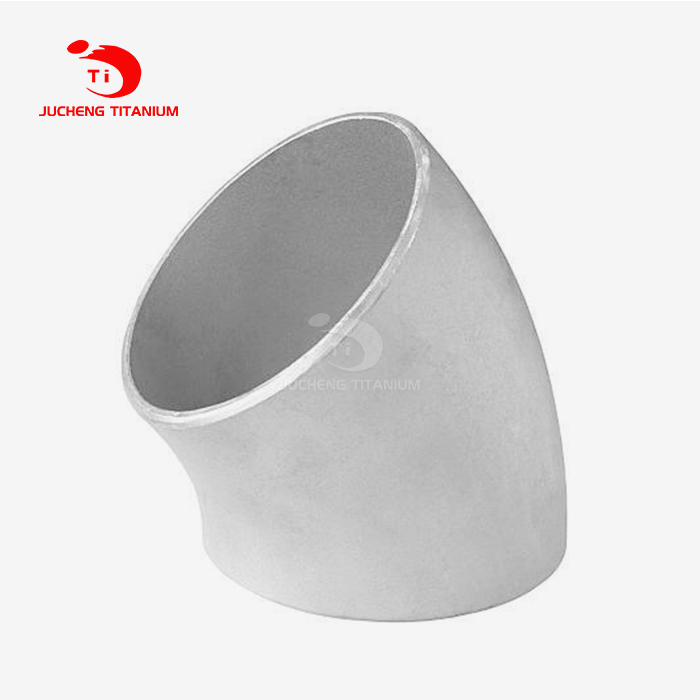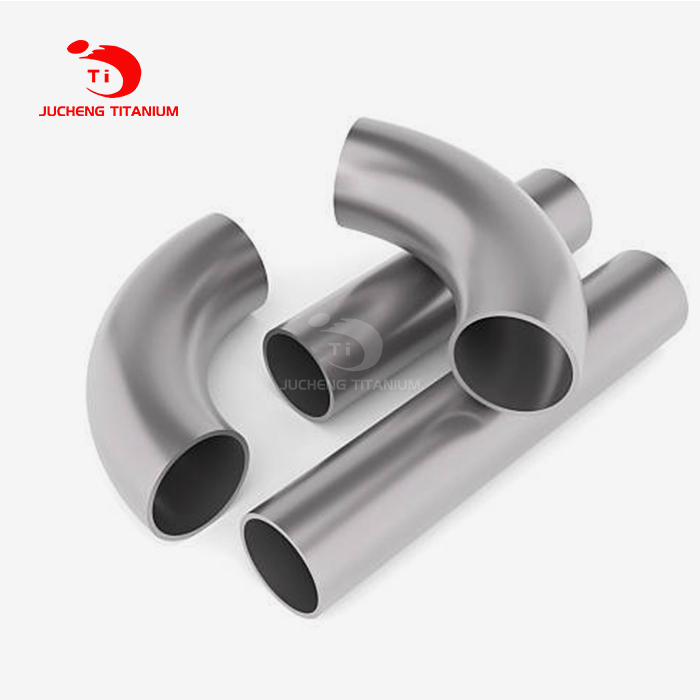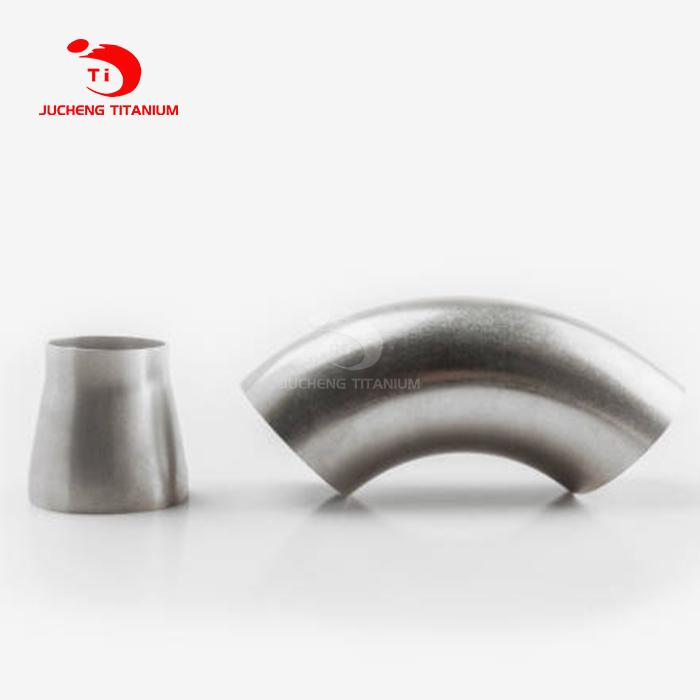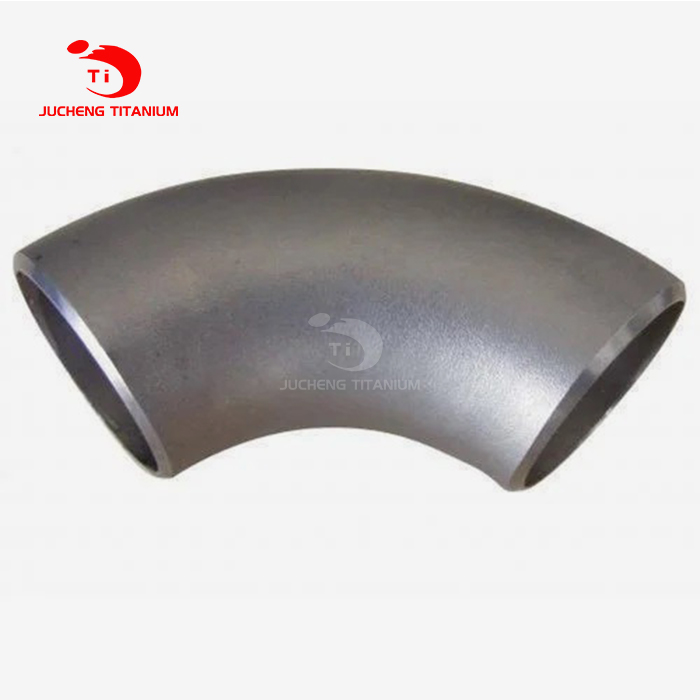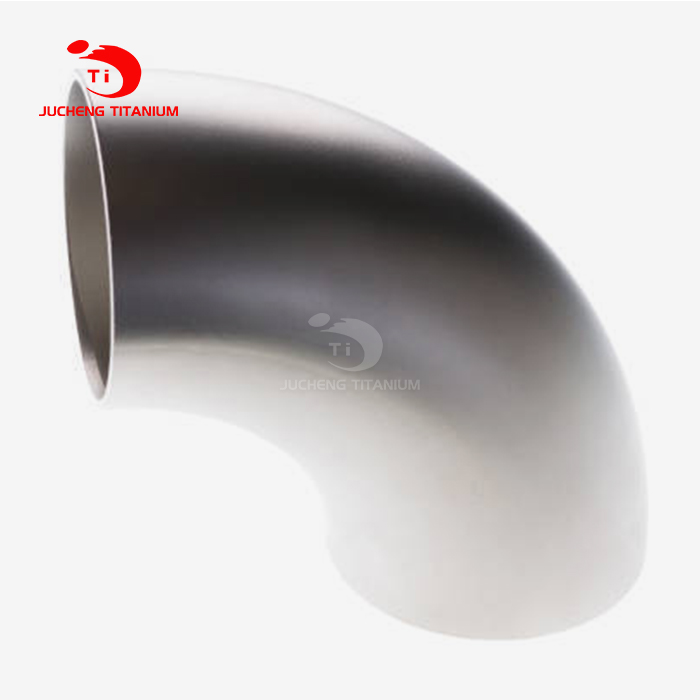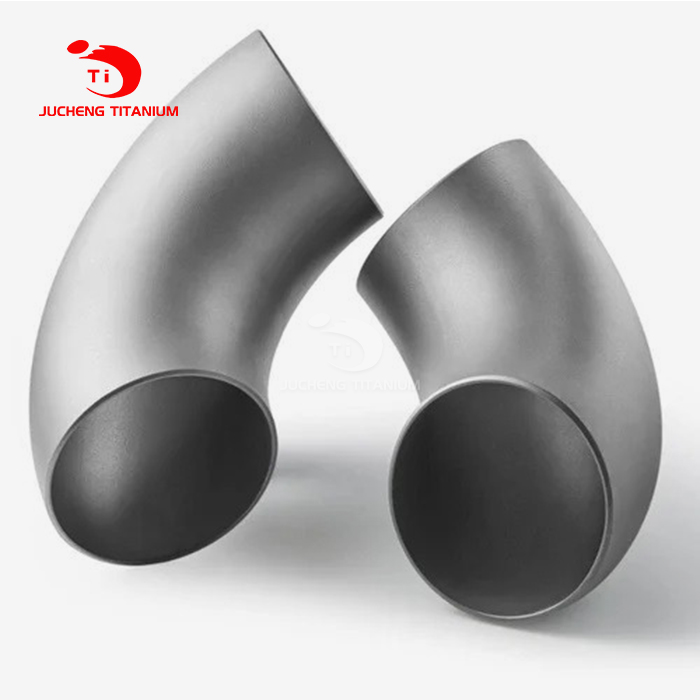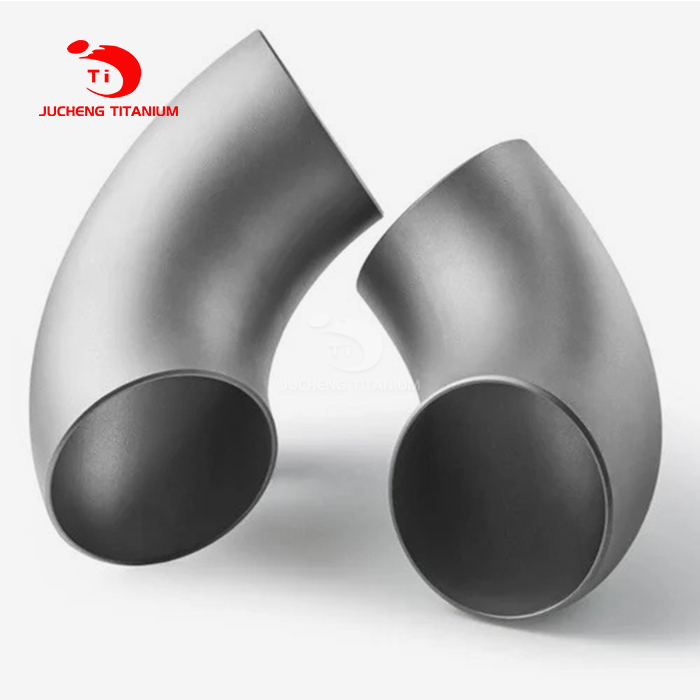

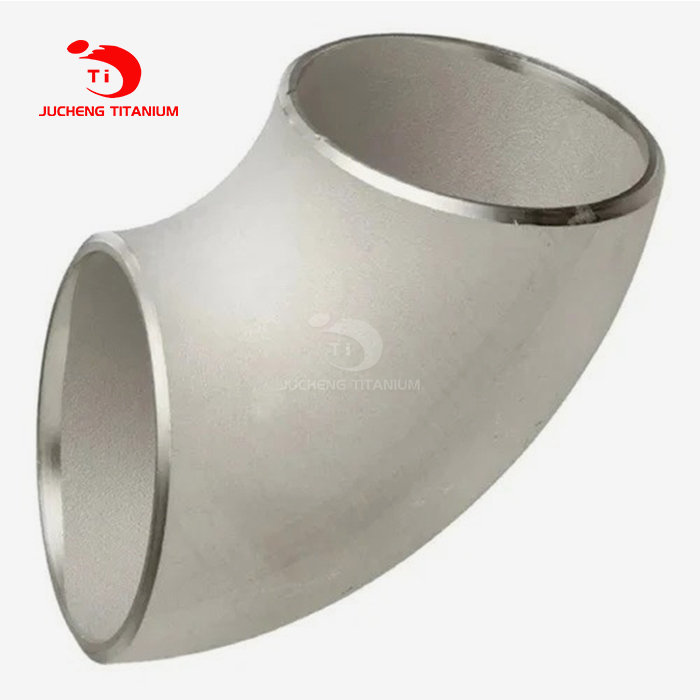
titanium elbow
2.Size: 1/2″ – 48″ (DN15 – DN1200), Seamless ≤ 24″, Welded ≥ 8″
3.Standard: ASME B16.9, MSS SP-43, DIN 2605, GB/T 27684
4.Type: 45° Elbow, 90° Long Radius, 90° Short Radius, 180° Return
5.Processing Method: Seamless: Extrusion + Pushing , Welded: Plate forming + Automatic TIG welding
6.State: Annealed
7.Surface Treatment: Inner & outer pickled, Sandblasted, Polished
- Product Description
Titanium Elbow – Precision-Engineered Pipe Fittings for Demanding Industrial Applications
Baoji Jucheng Titanium Industry Co., Ltd., located in China's Titanium Valley, delivers enterprise-grade titanium elbow solutions backed by over 20 years of manufacturing excellence. Our fittings are manufactured in 120,000 square meter, ISO-certified facilities that generate more than 500 sets of titanium equipment annually. According to ASME B16.9 requirements, every elbow is subjected to stringent quality procedures, such as PMI testing, UT/RT inspection, and dimensional verification. We guarantee quick fulfillment for projects requiring Gr1, Gr2, Gr5 (Ti-6Al-4V), Gr7, Gr9, and Gr12 alloys thanks to our ready inventory of 3,000 tons of titanium resources. Our seamless elbows offer unparalleled corrosion protection in chemical, marine, and aerospace pipe systems, with sizes up to 24 inches and welded versions up to 48 inches (DN1200).
 |  |  |  |
Product Specifications
Our titanium pipe elbows offer versatility for intricate piping systems and are made to international standards.
Parameter | Specification |
Grade | Gr1, Gr2, Gr5 (Ti-6Al-4V), Gr7, Gr9, Gr12 |
Size Range | 1/2″ – 48″ (DN15 – DN1200) |
Manufacturing | Seamless ≤ 24″ / Welded ≥ 8″ |
Standards | ASME B16.9, MSS SP-43, DIN 2605, GB/T 27684 |
Types | 45° Elbow, 90° Long Radius, 90° Short Radius, 180° Return |
Process | Seamless: Extrusion + Pushing / Welded: Plate forming + Auto TIG |
Condition | Annealed |
Surface Finish | Pickled, Sandblasted, Polished |
 |  |  |
 |  |  |
Quality Assurance Process
Dimensional Verification
We check wall thickness, OD tolerances, and center-to-face distances in accordance with ASME B16.9. This lowers the cost of rework by ensuring precise fit-up during field welding.
Material Composition Analysis
Handheld XRF spectrometry validates alloy grades. Iron content below 0.30% and oxygen within specification prevent embrittlement in your critical systems.
Non-Destructive Testing
· Ultrasonic Testing (UT): Detects laminations in seamless elbows
· Radiographic Testing (RT): Mandatory for welded variants to identify porosity
· Dye Penetrant (PT): Reveals surface cracks on high-stress extrados zones
Mechanical Property Verification
Tensile and flattening tests on raw material coupons confirm yield strength and ductility before forming operations commence.
 |  |  |  |
Application Scenarios
Chemical Processing Plants
Conventional materials quickly deteriorate in powerful acids and alkalis, which are handled by our Gr7 elbows. Your overall cost of ownership is decreased by shorter maintenance intervals.
Marine Engineering
Subsea control umbilicals and desalination systems demand zero-failure performance. Our fittings eliminate galvanic corrosion risks when interfacing with dissimilar metals through proper isolation kits.
Pharmaceutical Bioprocessing
Grade 2 elbows maintain ultrahigh purity in chromatography fluid transfer. Titanium's biological inertness prevents ion leaching into sensitive reagents.
Aerospace Fluid Systems
Hydraulic and pneumatic lines benefit from fatigue resistance under cyclic pressure. Our annealed condition ensures ductility for vibration-heavy environments.
 |  |  |
 |  |  |
Why Choose Our Titanium Elbow
Corrosion Immunity in Extreme Environments
Traditional steel fittings fail rapidly in seawater or acidic media. Our elbows resist chloride-induced pitting, extending service life by 15-20 years compared to stainless alternatives.
Lightweight Yet High-Strength
Grade 5 titanium elbow deliver 40% weight reduction versus steel equivalents. This advantage proves critical in aerospace hydraulic lines and offshore platforms where weight penalties translate to fuel costs.
Seamless or Welded Construction
For high-pressure applications (up to 5000 psi), you can use seamless versions. As an alternative, 100% radiographic testing guarantees weld integrity, and welded elbows offer cost-effectiveness for low-to-medium pressure lines.
Full Traceability and Certification
Every fitting includes EN 10204 3.1 Mill Test Certificates. Our PMI analysis confirms chemical composition within ASTM B363 limits, while UT and PT detect subsurface or surface defects before shipment.

Partner With Titanium Valley's Leading Manufacturer
Baoji Jucheng Titanium combines advanced production infrastructure with deep material science expertise. Our 41 utility model patents and 4 invention patents demonstrate continuous innovation in titanium forming technology.
As a National High-Tech Enterprise and "Little Giant" awardee, we maintain strategic partnerships with Northwest Nonferrous Metals Research Institute and Tsinghua University. This collaboration ensures your fittings incorporate cutting-edge metallurgical advancements.
FAQ
Q: What makes seamless elbows different from welded ones?
A: Solid billets are used to extrude seamless elbows, which are perfect for high-pressure critical loads. After passing 100% X-ray inspection, welded elbows, which use plate forming with a single TIG seam, offer cost savings for mild pressures.
Q: Is it possible to attach your elbows straight to stainless steel piping?
A: Direct contact in electrolytes results in galvanic corrosion even though they are mechanically compatible. To prevent the stainless anode from deteriorating too quickly, use flange isolation kits.
Q: How can I decide between designs with Long Radius (LR) and Short Radius (SR)?
A: To reduce pressure loss, specify LR (1.5D) for common configurations. Although SR (1.0D) increases fluid turbulence and friction losses, it is suitable for installations with limited space.
Q: Is heat treatment required after welding?
A: After forming, stress-relieving is required per ASTM B363. By doing this, residual stresses are eliminated and ductility is restored, avoiding hydrogen embrittlement or delayed cracking during operation.
Q: Why is Grade 2 the most widely used alloy?
A: It strikes a balance between cost, formability, weldability, and exceptional corrosion resistance. Although Grade 5 is stronger, Grade 2's commercially pure composition can withstand more corrosive conditions.
Contact Us
Ready to eliminate corrosion failures and reduce lifecycle costs? Our technical team provides custom solutions for your specific fluid system requirements.
Reach us at s4@juchengti.com for quotations, technical drawings, or material selection guidance. Let's build reliable titanium elbow together.