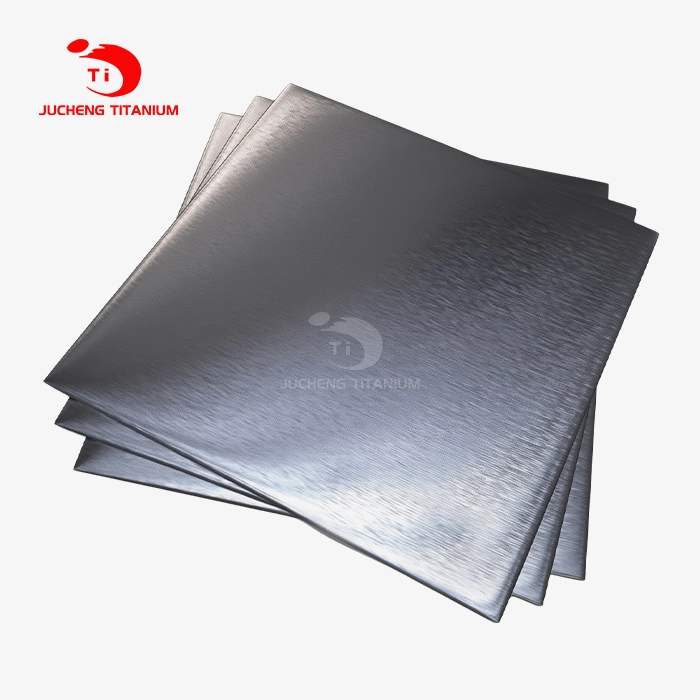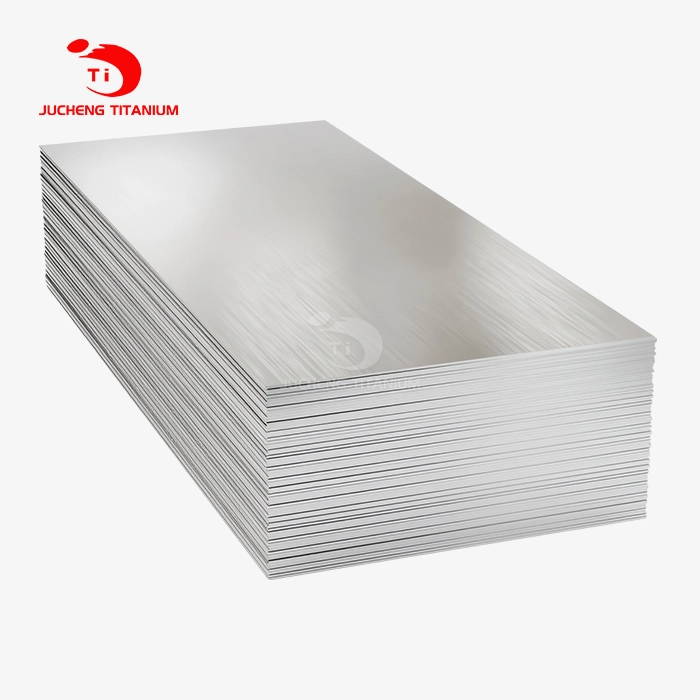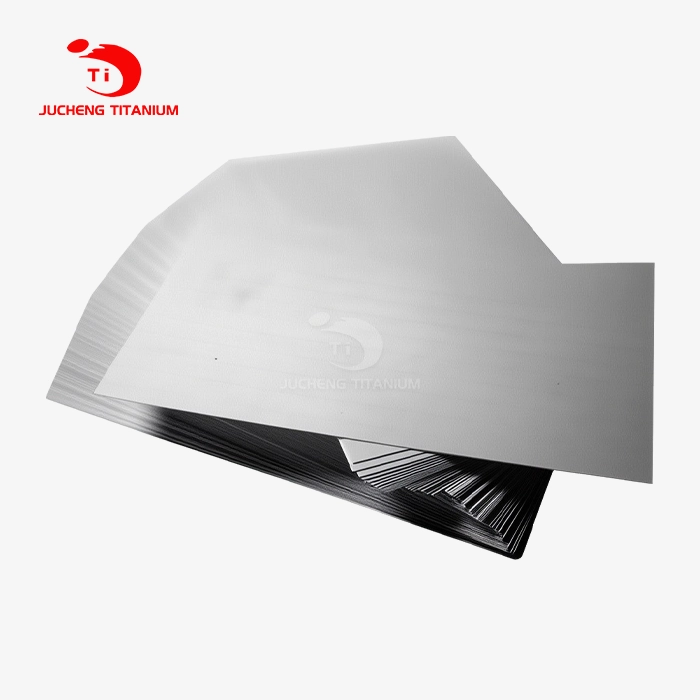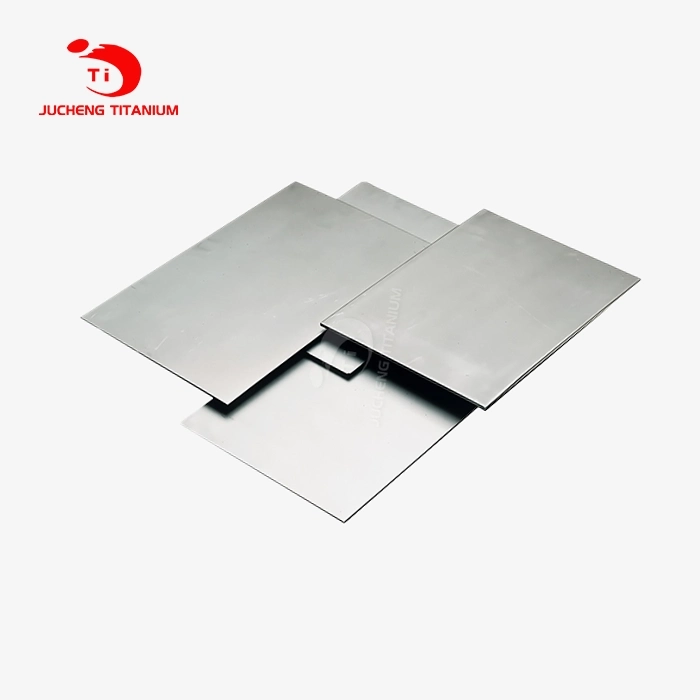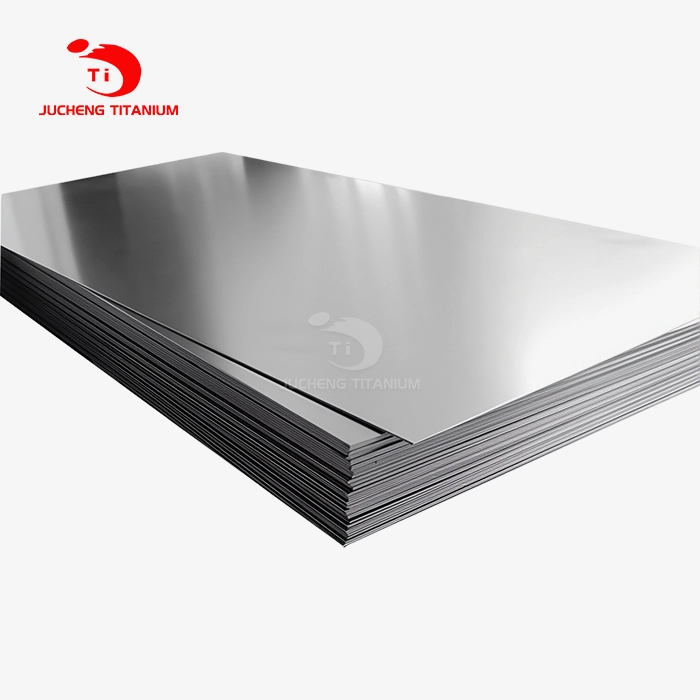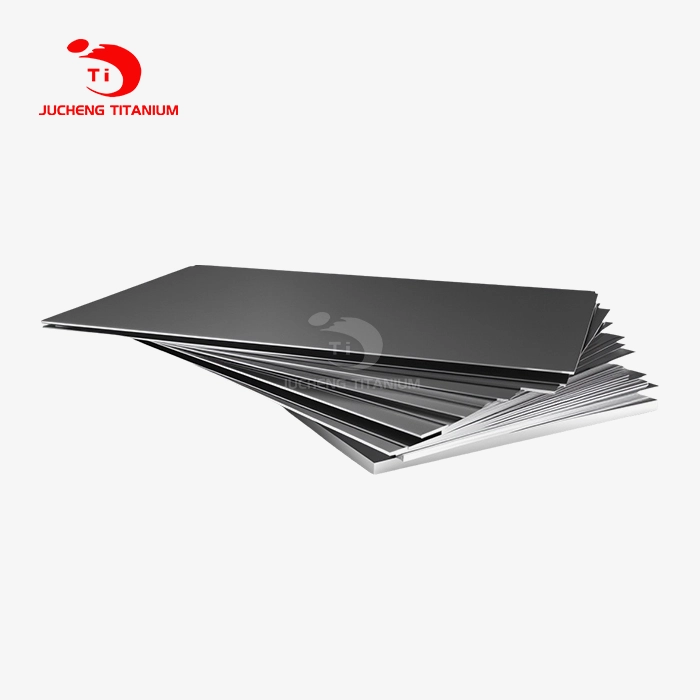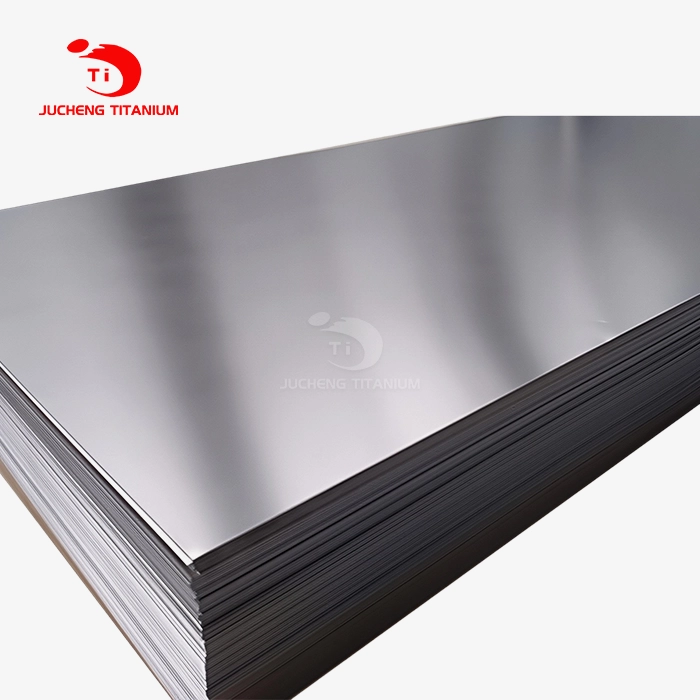

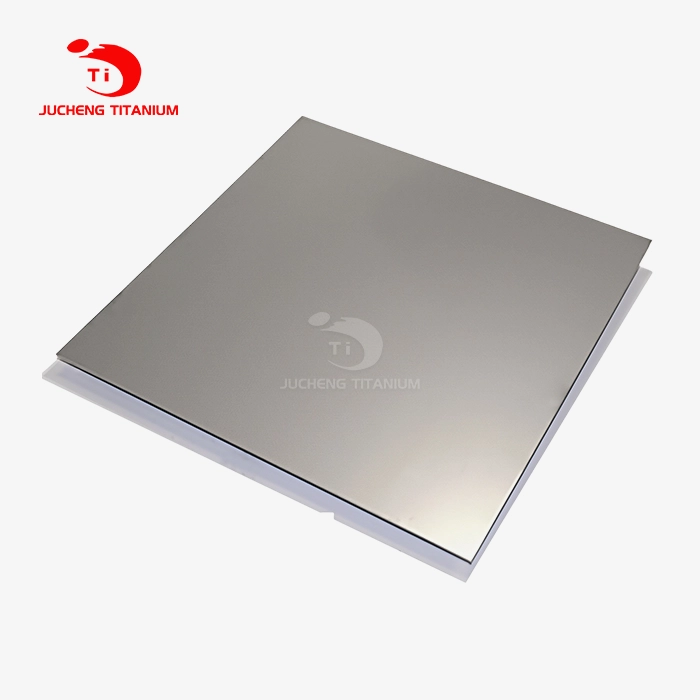
gr1 titanium plate
2. Size: Thickness 4mm–80 mm, 950≤ Width ≤ 2500 mm, Length ≤ 10000 mm, or customized
3. Standard: ASTM B265, ASTM F67, AMS 4911, ASME SB265
4.Type: Hot Rolled
5. Processing Method: Rolling, Annealing, Leveling,Pickling,Surface Finishing
6. State: Annealed
7. Surface Treatment:Polished, Machined, Acid Pickled
- Product Description
GR1 Titanium Plate: Superior Ductility for Precision Industrial Applications
Baoji Jucheng Titanium Industry Co., Ltd. creates superior gr1 titanium plate that satisfies strict ASME SB265 and ASTM B265 requirements by utilizing more than 20 years of titanium manufacturing experience. Our plant has over 3,000 tons of titanium on hand all year long to guarantee quick delivery. Our plate offers excellent cold formability with a density of 4.51 g/cm³ and remarkable elongation of over 30%. While the oxygen concentration is exactly below 0.18%, the minimum yield strength is 138 MPa and the minimum tensile strength is 240 MPa. We can produce more than 500 pieces of titanium equipment each year, meeting a wide range of industry needs from maritime engineering to chemical processing.
 |  |  |  |
 |  |  |  |
Technical Specifications
Parameter | Specification |
Grade | Gr1, Gr2, Gr4, Gr5, Gr7, Gr9, Gr12 |
Thickness | 4 mm – 80 mm |
Width | 950 mm – 2,500 mm |
Length | Up to 10,000 mm (customizable) |
Standard | ASTM B265, ASTM F67, AMS 4911, ASME SB265 |
Type | Hot Rolled |
State | Annealed |
Surface Treatment | Polished, Machined, Acid Pickled |
Density | 4.51 g/cm³ |
Elongation | Min 24% (typically >30%) |
Bend Radius | 1T without cracking |
 |  |  |
 |  |  |
Quality Assurance Process
Our comprehensive inspection protocols include:
Chemical Analysis: ICP-OES and inert gas fusion testing verify interstitial element compliance. Every batch undergoes strict verification to maintain oxygen below 0.18%.
Mechanical Testing: Room temperature tensile tests per ASTM E8 confirm yield strength and elongation values. Bend testing at 105 degrees around a 1T mandrel ensures formability standards.
Microstructure Examination: Grain size analysis per ASTM E112 guarantees uniform forming properties. Our fully annealed equiaxed alpha phase structure delivers predictable performance.
Non-Destructive Testing: Ultrasonic inspection per AMS 2631 Class A1 detects internal discontinuities. Flatness tolerance verification ensures dimensional accuracy for cladding applications.
 |  |  |  |
Industry Applications
Our varied application experience is beneficial to your projects:
Chemical Processing: Aggressive media are safely handled using reactor vessels, heat exchangers, and pickling apparatus.
Marine Engineering: Offshore platform components and seawater desalination plants successfully withstand corrosion caused by chloride.
Medical Equipment: Non-magnetic, biocompatible qualities are ideal for the production of implants and surgical equipment.
Aerospace Components: For aviation uses, lightweight structural components combine formability and strength.
 |  |  |
 |  |  |
Manufacturing Excellence
Our 120,000-square-meter facility integrates vacuum arc remelting controls that minimize embrittling interstitial impurities.
Advanced heat treatment facilities and precision machining lines ensure consistent quality from raw material to finished product. Professional technical teams optimize processes continuously based on customer feedback.
Cooperation with Northwest Nonferrous Metals Research Institute and Tsinghua University strengthens our innovation capabilities.
Why Choose Our GR1 Titanium Plate
Unmatched Cold Formability
You get the best deep-drawing capability among all titanium grades.
Our gr1 titanium plate achieves tight bend radii of 1T thickness without surface cracking or orange-peeling. This characteristic proves essential for manufacturing complex heat exchanger components and pressure vessel cladding.
The single-phase alpha structure ensures consistent forming behavior across the entire sheet.
Exceptional Corrosion Resistance
Your equipment faces harsh chemical environments daily.
Our material provides superior resistance to seawater, chloride solutions, nitric acid, and wet chlorine atmospheres. The low oxygen content (≤0.18%) and minimal iron contamination (≤0.20%) create an electrochemically inert surface that outperforms stainless steel alternatives.
This translates to extended service life and reduced maintenance costs.
Superior Weldability
Joining titanium shouldn't compromise your component integrity.
GR1 maintains excellent ductility in the heat-affected zone during TIG and MIG welding. You don't need post-weld heat treatment, simplifying your fabrication process significantly.
Using ERTi-1 filler metal ensures consistent mechanical properties throughout welded assemblies.

Frequently Asked Questions
Q: What distinguishes GR1 from GR2 titanium plate?
A: GR1 contains lower oxygen and iron levels, resulting in softer material with approximately 170 MPa yield strength compared to GR2's 275 MPa. Choose GR1 for deep drawing and explosion cladding where maximum ductility matters.
Q: Can you harden GR1 through heat treatment?
A: No. As a commercially pure alpha alloy, GR1 doesn't respond to heat treatment. Strengthening occurs only through cold working, which reduces ductility. We supply material in the annealed condition for optimal formability.
Q: What temperature limitations apply?
A: GR1 performs reliably below 300°C. Beyond this threshold, strength decreases and oxidation susceptibility increases. For elevated temperatures, consider Grade 5 or Grade 12 alloys instead.
Q: How do you verify authentic GR1 material?
A: We provide EN 10204 3.1 Mill Test Certificates documenting chemical composition. Our GR1 typically measures 120 HB hardness, distinguishing it from GR2's 160 HB.
Q: Which welding filler should you use?
A: ERTi-1 filler metal per AWS A5.16 provides matching composition and properties. Higher-grade fillers create stronger but less ductile weld beads unsuitable for formed components.
Contact Us
Ready to source high-quality gr1 titanium plate for your project? Our technical team stands ready to discuss your specific requirements. Contact us at s4@juchengti.com for quotations, technical specifications, or custom manufacturing solutions.