
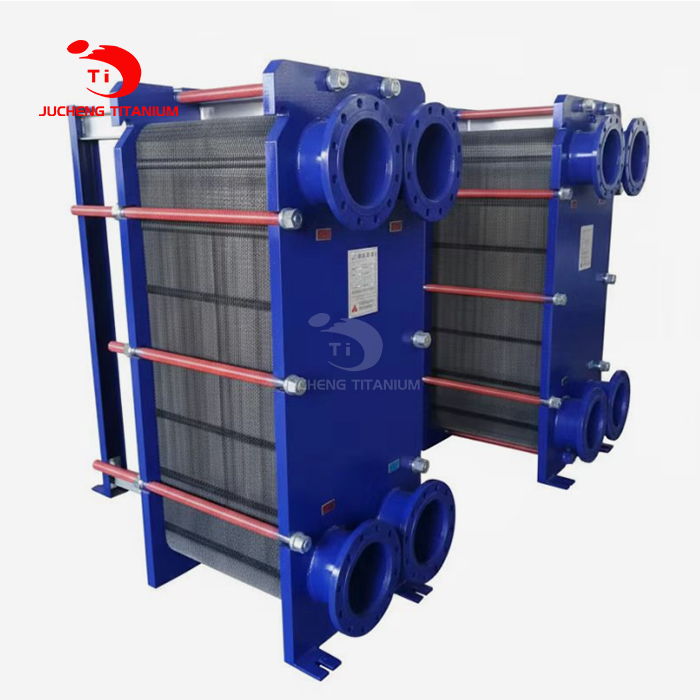
Titanium Plate Heat Exchanger
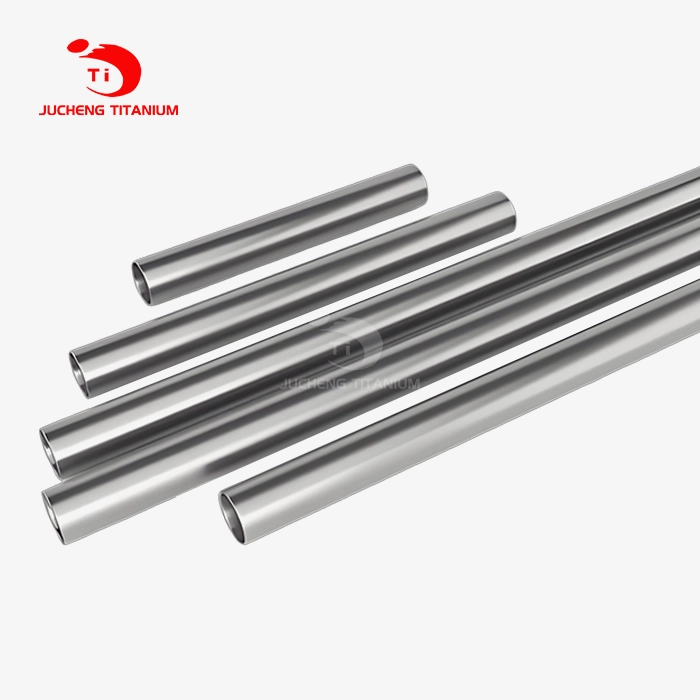
2.Size: Shell diameter: Φ100 – Φ3000 mm , Heat transfer area: 0.5 m² – 2000 m² ,Tube length: ≤ 12,000 mm - Fully customizable
3.Standard: ASME VIII-1, EN 13445, GB/T 151, PED 2014/68/EU
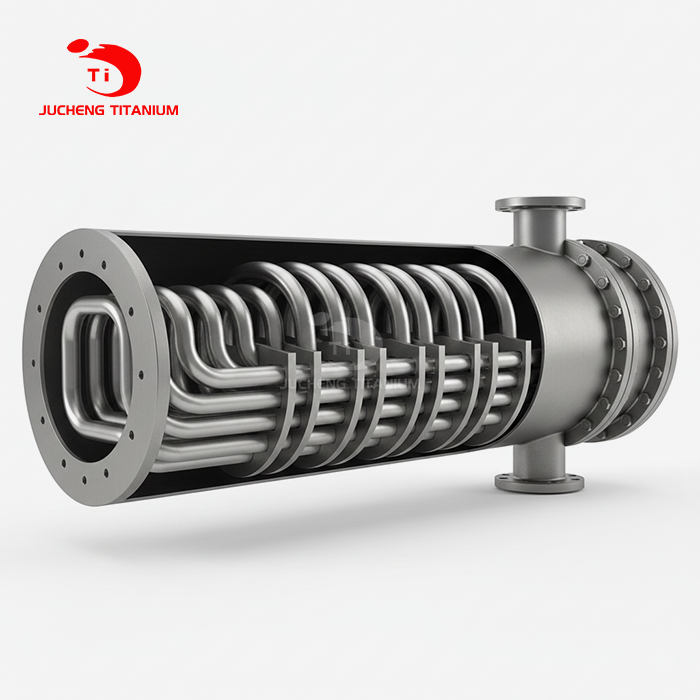
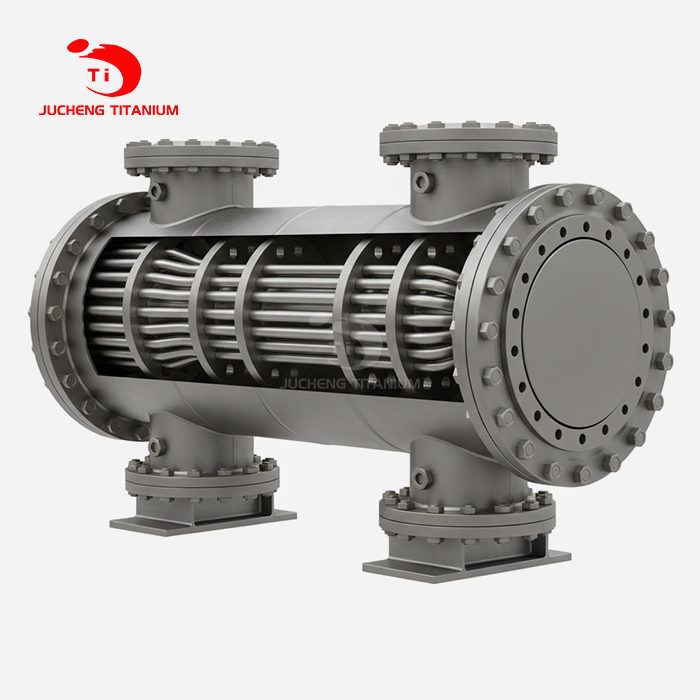
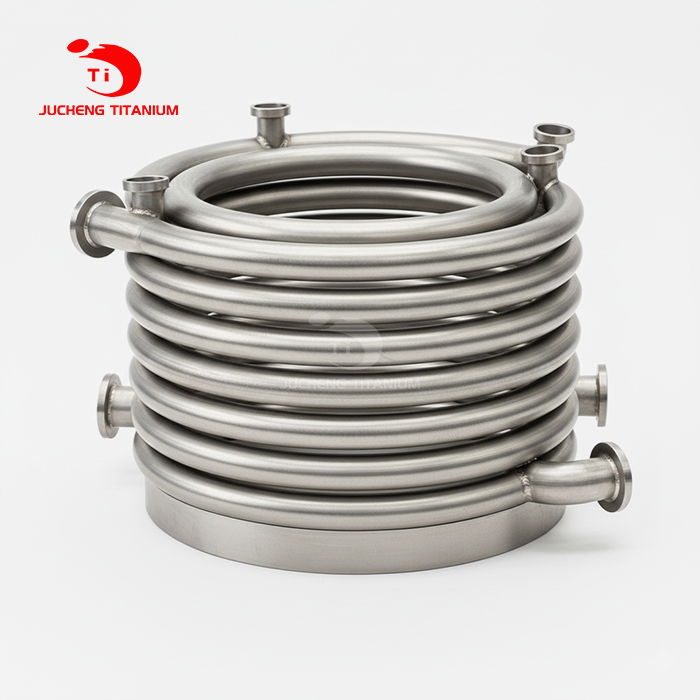
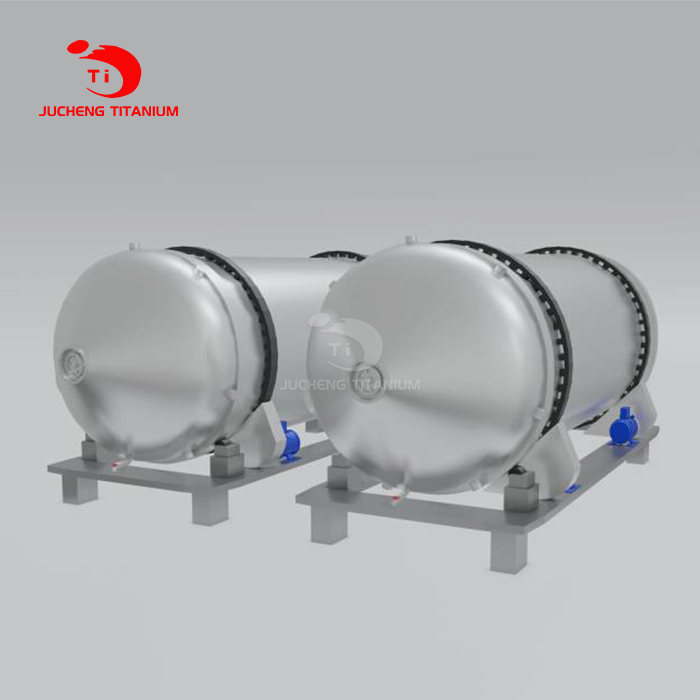
4.Type: Shell & Tube (Fixed tubesheet, U-tube, Floating head), Plate heat exchanger, Immersion coil, Tube bundle
5.Processing Method: Seamless/welded tube → Tube sheet drilling → Tube-to-tubesheet expansion + seal welding + strength welding → Shell rolling & welding → Full assembly → Final testing
6.State: Annealed
Surface Treatment: Inner & outer pickled, Sandblasted, Electropolished
- Product Description
Titanium Plate Heat Exchanger
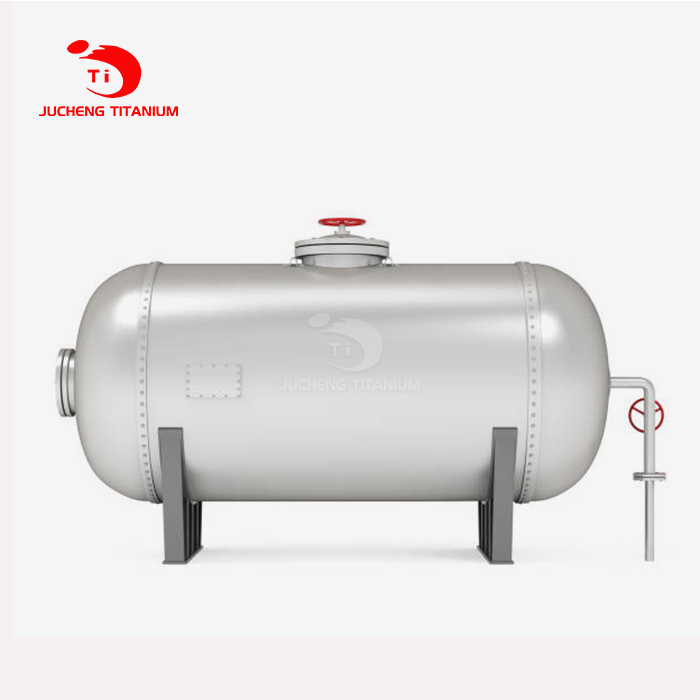
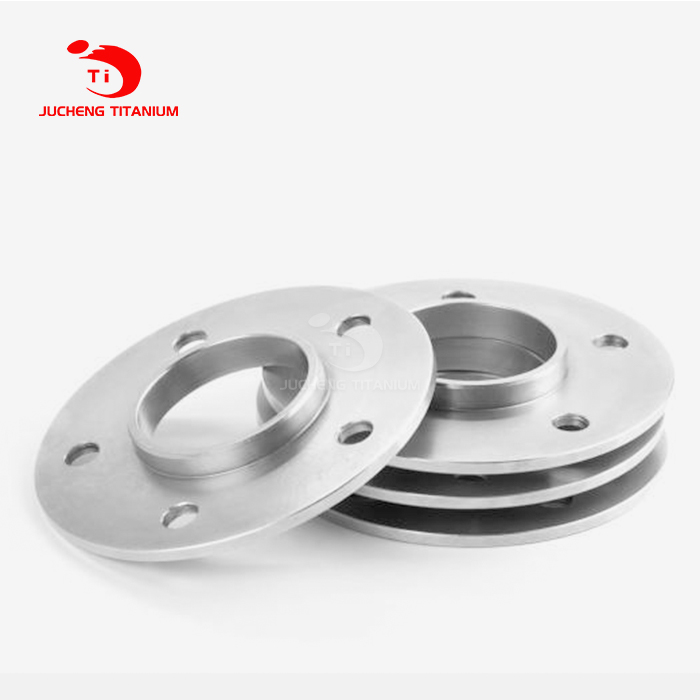
Baoji Jucheng Titanium Industry Co., Ltd manufactures industrial-grade Titanium Plate engineered for environments where conventional alloys fail. Built from ASTM B265 Gr.1 and Gr.2 titanium, our units deliver a heat transfer coefficient ranging from 3000 to 7000 W/m²·K while maintaining complete immunity to chloride-induced corrosion. With over 20 years of titanium manufacturing expertise and an annual production capacity exceeding 500 sets of titanium equipment, For quick deployment, we keep about 3,000 tons of titanium on hand. Each Titanium Plate Heat Exchanger features plate thickness of 0.5mm to 1.0mm, shell diameters from Φ100 to Φ3000 mm, and regions of heat transport between 0.5 and 2000 m². Our production facilities adhere to GB/T 151, EN 13445, and ASME VIII-1 requirements.
 |  |  |  |
Why Titanium Outperforms Stainless Steel
In seawater or brine applications, your current stainless steel systems are prone to pitting and crevice corrosion. When chloride concentrations surpass 1000 ppm at high temperatures, conventional SS316L deteriorates.
The self-healing TiO₂ oxide layer that titanium generates offers complete defense against saline attack. In forceful fluids when traditional materials breakdown, this natural barrier preserves structural integrity. You get rid of unscheduled downtime brought on by material fatigue and leaks.
Compared to rougher ferrous metals, titanium surfaces' natural smoothness effectively prevents biofouling. The collection of algae and barnacles is greatly reduced, which lowers the frequency of maintenance and maintains thermal performance over the course of operation.
Technical Specifications Of Titanium Plate Heat Exchanger
Parameter | Specification |
Grade | Gr1, Gr2, Gr7, Gr9, Gr12 |
Shell Diameter | Φ100 – Φ3000 mm |
Heat Transfer Area | 0.5 m² – 2000 m² |
Tube Length | ≤ 12,000 mm (fully customizable) |
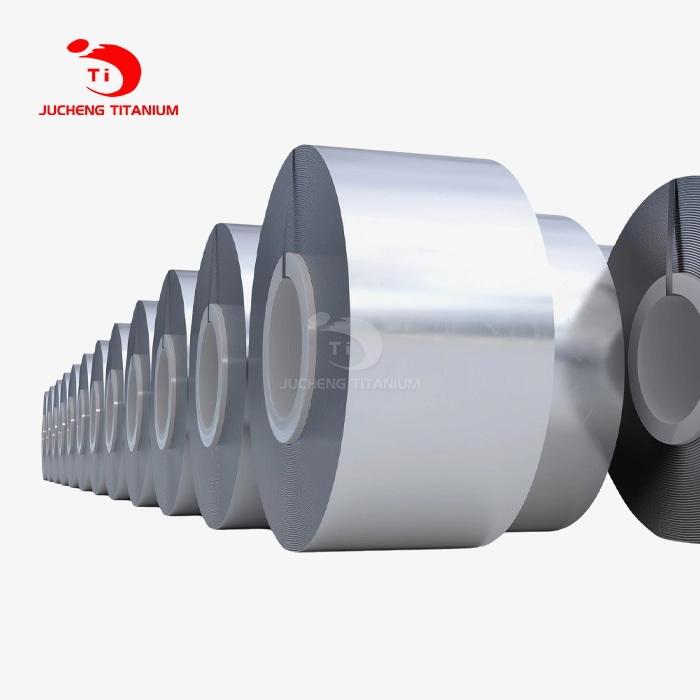
Plate Thickness | 0.5 mm – 1.0 mm |
Standards | ASME VIII-1, EN 13445, GB/T 151, PED 2014/68/EU |
Type | Shell & Tube (Fixed tubesheet, U-tube, Floating head), Plate heat exchanger |
State | Annealed |
Surface Treatment | Pickled, Sandblasted, Electropolished |
 |  |  |
 |  |  |
Manufacturing Process
We follow stringent fabrication protocols to ensure zero-defect delivery. Seamless or welded tubes undergo precision drilling for tube sheet integration. Tube-to-tubesheet connections combine expansion, seal welding, and strength welding techniques.
Shell components receive rolling and welding treatments before full assembly. Each unit undergoes comprehensive final testing including pressure testing and non-destructive examination. Our quality control team monitors every production stage to meet international compliance standards.
 |  |  |  |
Critical Applications
Marine & Offshore Systems: Your vessel's central cooling system requires reliable seawater-to-freshwater heat transfer. Our Titanium Plate Heat Exchanger withstands erosion-corrosion from high-velocity seawater mixed with sand and silt, protecting engine cooling loops on ships and oil platforms.
Chlor-Alkali Production: You need equipment that survives wet chlorine gas and hypochlorite solutions. Titanium is among the few metals that resist the highly oxidizing nature of wet chlorine without dissolving, ensuring process safety and product purity.
Seawater Desalination: SWRO plants demand equipment capable of handling concentrated brine under high operating pressures. Our exchangers perform temperature regulation and energy recovery where pitting corrosion would be catastrophic for standard alloys.
Geothermal Energy: Your heat extraction loops face high-mineral, corrosive fluids. The Titanium Plate provides a robust interface between aggressive subterranean brines and clean secondary power cycles.
 |  |  |
 |  |  |

FAQ
Q: What chloride concentration can titanium handle?
A: Titanium maintains stability in seawater and brine solutions at all practical chloride concentrations, even at temperatures up to 120°C, far exceeding the failure threshold of SS316L.
Q: How does thermal conductivity compare to steel?
A: While titanium's conductivity (~17 W/m·K) is lower than carbon steel, thinner plate construction (0.5mm) and resistance to fouling achieve overall K-values of 3000-7000 W/m²·K.
Q: What delivery time can I expect?
A: Our 3,000-ton titanium inventory enables rapid response. Standard configurations ship within shortened cycles, while customized units follow project-specific timelines.
Q: Which grades suit acidic environments?
A: Grade 7 (with palladium) and Grade 12 (with molybdenum and nickel) offer enhanced resistance to reducing acids beyond standard Gr1 and Gr2 capabilities.
Contact Us
Request technical specifications or customized solutions for your corrosive fluid challenges. Reach our engineering team at s4@juchengti.com for Titanium Plate Heat Exchanger application-specific consultation.