



Common forming errors when stamping CP grade 4 titanium sheet
When stamping CP grade 4 titanium sheet, even experienced fabricators encounter persistent quality issues — cracking at bend zones, excessive springback, and surface tearing that drive up scrap rates. Grade 4 is the strongest of the commercially pure (CP) titanium grades, with a minimum UTS of 550 MPa and yield strength of 480 MPa, but that strength comes with reduced formability compared to Grade 2. Understanding where the process goes wrong is the first step toward getting it right.
Understanding CP Grade 4 Titanium Sheet and Its Forming Characteristics
Mechanical Properties That Affect Forming
Grade 4 titanium sheet is strong because it has a lot of oxygen (up to 0.40 wt%) and iron (up to 0.50 wt%) in its intermediate material. These additions make the material stronger, but they also make it less flexible, with a minimum elongation of 15%. When the material is stamped, this means it doesn't handle sharp corners or fast forming as well. Grade 4 needs more careful process tuning at every step than Grade 2 (UTS ~345 MPa).
Standard Specifications and Product Dimensions
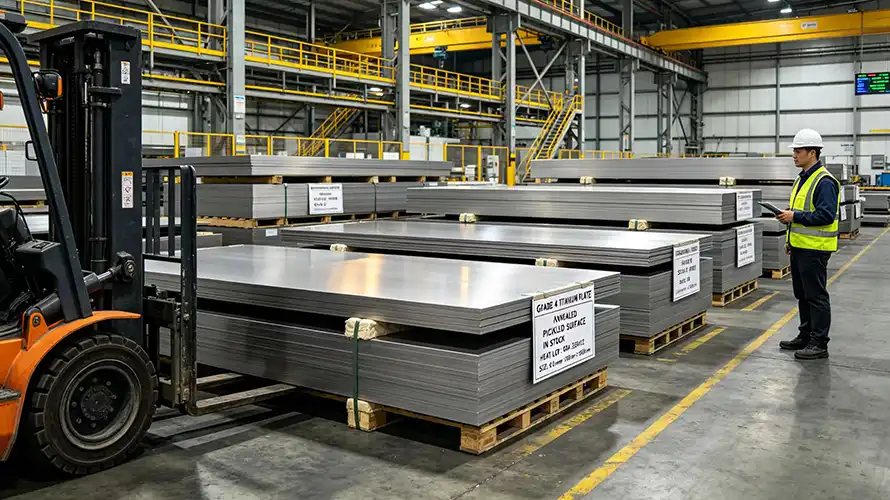
In the annealed state, Jucheng Titanium sells hot-rolled Grade 4 sheet that meets ASTM B265, ASME SB265, AMS 4911, and ASTM F67. Thicknesses range from 4 mm to 80 mm, widths from 950 mm to 2,500 mm, and lengths up to 10,000 mm. Custom sizes are also possible. Acid pickling, polishing, and machined finishes are some surface treatments that change how the surface rubs against the die during forming.
Why the Annealed Condition Matters
After hot rolling, annealing lowers the stress inside the material and makes it more flexible again. When sheets are rolled, heated, leveled, and pickled, they end up with a uniform alpha-phase architecture. Non-uniform grain structures are a direct cause of localized cracking during deep drawing or bending, so this uniformity is very important. Before putting sheet into a press, you should always check the state of the material.
Common Forming Errors in Stamping CP Grade 4 Titanium Sheet
Insufficient Bend Radius Leading to Cracking
The most common mistake I see is not giving enough information about the bend radius. When cold forming Grade 4 titanium, the bend radius must be at least 3T, which is three times the thickness of the sheet. Some sources say that the radius must be between 2.5T and 3T under controlled conditions, as shown by the ASTM E290 semi-guided bend test. When you use a radius below this level, the tensile stress is concentrated at the outer fiber, which starts cracks that quickly spread through the section. Do not be too exact with your radius when you are working close to the limit of flexibility.
Excessive Springback Due to High Yield Strength
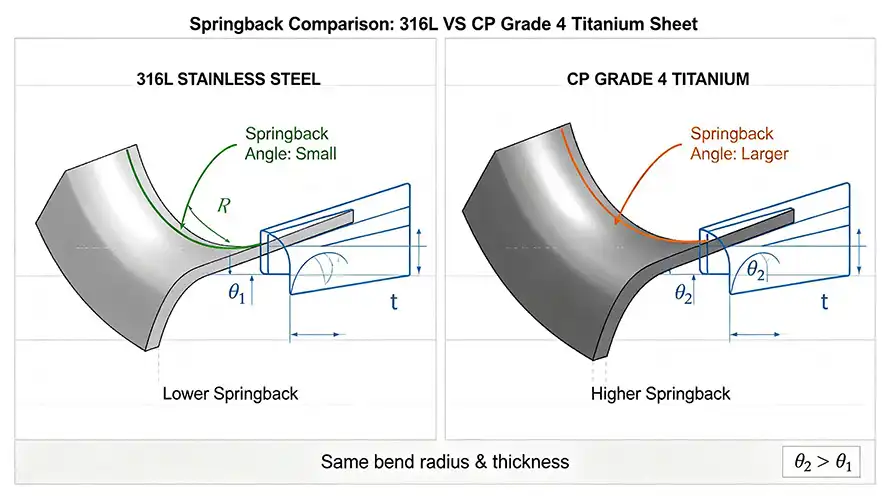
The amount of springback in a CP grade 4 titanium sheet is related to the yield strength. At a minimum yield of 480 MPa, Grade 4 titanium springs back a lot after the punch is pulled out. If fabricators use the same overbend adjustment for aluminum as they do for steel, they will not fix the problem enough. To fix it in real life, you would have to test each combination of thickness and radius and then build a correction table into the tooling setup. The shape of the die needs to take into account titanium's elastic rebound, which is usually 5° to 15° higher than the same processes done with stainless steel.
Surface Galling and Scoring From Inadequate Lubrication
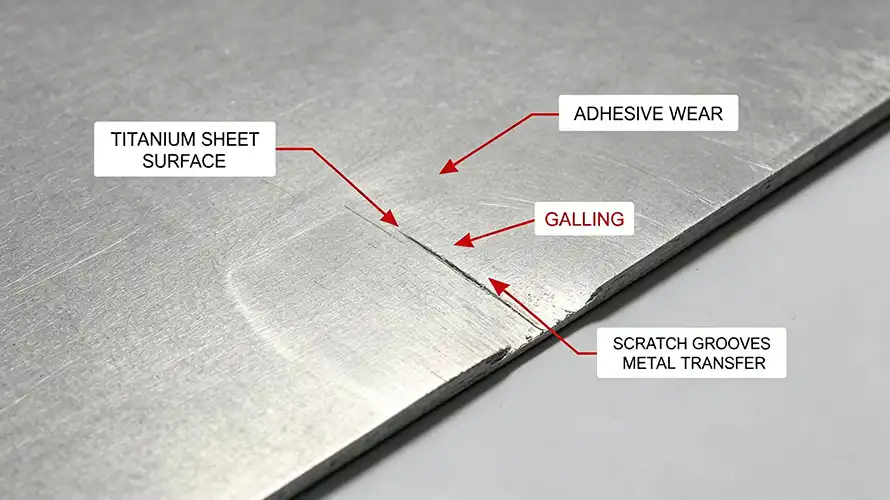
Titanium grade 4 tends to gall against steel tools because it doesn't conduct heat well and sticks to things easily. If you don't use the right lubricant—chlorinated drawing chemicals or fluoropolymer films are often suggested—the sheet surface will score against the die face. This leaves tool marks on the part that change its shape and, in chemical or aerospace settings, start corrosion. After each production run, check the dies and re-oil them.
Analysis of Root Causes and Practical Problem-Solving Principles
Material Inconsistency at the Source
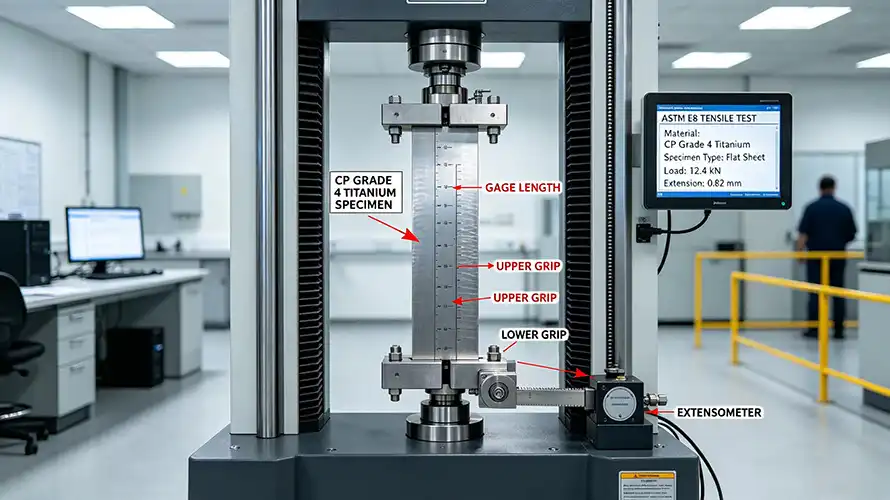
A lot of flaws in the making come from the sheet that goes in, not the press. Changing the amount of oxygen in a coil can make hard and soft bands that react differently to the same amount of pressure. The people in charge of buying things should demand chemistry testing according to ASTM E120/E1941, tension testing according to ASTM E8, and a microstructure check to make sure there is no alpha case. Alpha case is the brittle oxygen-rich surface layer that forms when annealing isn't done right. Verified material traceability is necessary for controlling the yield rate and can't be skipped.
This is what a good new inspection list includes:
- Chemical verification: Confirm oxygen ≤ 0.40% and iron ≤ 0.50% per heat certificate.
- Mechanical confirmation: Tensile test results showing UTS ≥ 550 MPa and elongation ≥ 15%.
- Bend test compliance: Semi-guided bend at 2.5T–3T radius with no visible cracking per ASTM E290.
- Surface integrity: Dye penetrant inspection (DPI) or ultrasonic testing to rule out laps, seams, or inclusions.
- Chemical check: Make sure the oxygen level is 0.40%, and the iron level is 0.50% as stated on the heat certificate.
Tool Wear and Die Condition
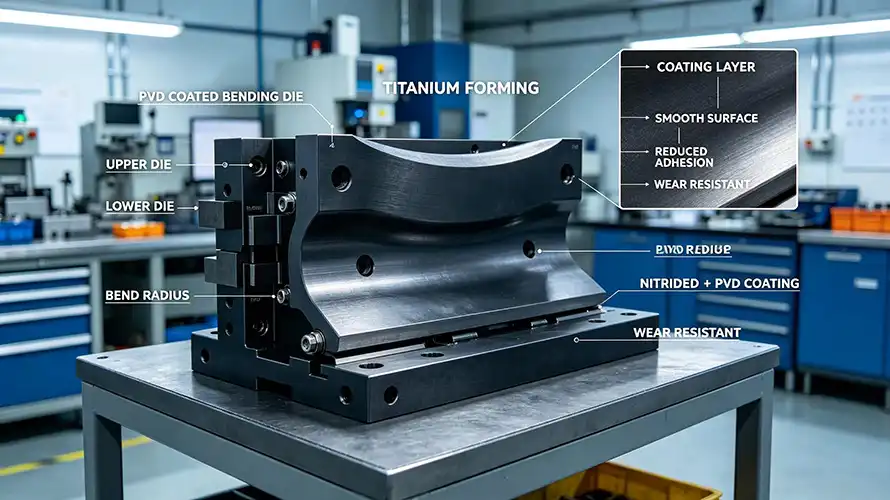
The useful forming shape changes little by little as the die edges wear down. If a die made for a 3T radius has worn down to 2.5T from titanium contact, cracks may happen even if the user doesn't change how they're set up. Die inspections on a regular basis and checking the strength of tool steel surfaces on a regular basis are important preventative measures. When forging titanium, hard chrome finishing or PVD coating on the dies makes them last a lot longer.
Process Parameter Calibration
Titanium's behavior is directly affected by how fast it is formed. Titanium generates localized heat at high ram speeds that raises the risk of adhesion and galling. When the press speed is managed, and the pressure on the blank holder is right, the friction heat is reduced. This gives the material time to deform plastically instead of breaking. The most effective way to keep things consistent is to write down a qualified process window for each part shape and make sure that it is followed through CNC press control.
Comparing Grade 4 Titanium With Other Materials in Stamping Applications
Grade 4 vs. Grade 2 Titanium
Because it is more flexible and has less springback, Grade 2 titanium is the most common grade used for stamping. But Grade 2 doesn't always have the structural strength that is needed in chemical processing tanks that need to be resistant to wet chlorine or nitric acid under pressure. A CP grade 4 titanium sheet fills that need: it has the same resistance to rust but a 60% higher UTS. In exchange, the making process has to be more carefully handled, and more tools have to be made.
Grade 4 vs. Grade 5 (Ti-6Al-4V)
Grade 5 is even stronger—UTS is usually above 900 MPa—but its alpha-beta lattice makes cold forming not possible for most sheet uses. Although Grade 4 is stronger than Grade 3, it is much easier to stamp cold. It is used for airplane skins, shields, and chemical reactor liners. If procurement teams have to choose between the two, Grade 4 is the cheaper option when the design doesn't need tensile properties at the alloy level.
Grade 4 vs. Stainless Steel 316L
It is easier and cheaper to shape 316L stainless steel, but it doesn't work well in high-chloride or reducing acid conditions. That's where Grade 4 titanium shines. The lifecycle cost of titanium is lower for offshore desalination equipment, deep-sea hardware, and chemical distillation columns because they don't need to be replaced as often. Forming Grade 4 is hard, but that's only a one-time technical problem. Stainless steel rust is a constant cost of doing business.
Procurement and Supplier Considerations for CP Grade 4 Titanium Sheets
Certification and Traceability Requirements
Certification of the material is required for use in aircraft and medicine. Suppliers must give mill test records (MTRs) that can be linked to the exact heat and show that they meet ASTM B265 or AMS 4911 standards. For use in medical implants, ASTM F67 approval is needed. Before giving the supplier a purchase order, make sure that they have well-documented quality systems and can send certificates with every shipment.
Custom Dimensions and Surface Finish Selection
Standard stock sizes don't always match the needs of printing blanks. Working with a supplier that can cut to any size—from 4 mm to 80 mm thick, 2,500 mm wide, and 10,000 mm long—cuts down on waste during blank preparation and increases material yield. The finish on the surface is also important. Acid-pickled surfaces are clean and free of oxides, which makes them perfect for shaping. Polished or machined finishes are better for uses that need tight measurement standards.
Long-Term Supply Reliability
Titanium supply lines were unstable in 2022 and 2023, and wait times for specific grades went up to 16 to 20 weeks. Building a relationship with a supplier who keeps more than 3,000 tons of stock on hand greatly lowers the risk to the project schedule. A seller who keeps stock of Gr1, Gr2, Gr4, Gr5, Gr7, Gr9, and Gr12 makes it easier for distributors and OEM makers to place repeat orders. This is because the supplier can meet the needs of multiple projects.
Conclusion
To successfully stamp CP grade 4 titanium sheet, you need to pay attention at every step: find certified material, make sure the die shape meets the 3T bend radius requirement, control the forming speed and lubrication, and check each arriving coil. The material is useful for aerospace structures, chemical tanks, and naval gear because it has a high yield strength. However, the forming process needs to be more controlled because of this strength compared to softer CP types. When procurement teams work with certified, experienced titanium suppliers, the number of defects goes down, lead times get shorter, and the total cost of the project goes down. Choosing the right source and defining the materials correctly from the start is the best way to avoid making mistakes.
FAQ
1. Why does Grade 4 titanium crack more easily than Grade 2 during bending?
Grade 4 has more oxygen and iron than Grade 3, which makes it stronger but less flexible. It can stretch 15% less than Grade 2, and its yield strength of 480 MPa means that more stress builds up at the bend zone. When you use a bend radius less than 3T, you put too much stress on the material, which can cause it to break.
2. What lubrication works best when stamping Grade 4 titanium sheet?
Fluoropolymer-based films and chlorinated drawing compounds are often used. These keep titanium and steel tools from sticking together, which stops galling and surface cutting. It's necessary to reapply between runs, especially when making a lot of parts.
3. How do I control springback in Grade 4 titanium stamping?
Overbend adjustment has to be set up by trial and error for each thickness and radius. You can expect 5° to 15° more springback than with stainless steel operations of the same type. The most consistent results come from CNC press settings with written forming windows.
4. Can Grade 4 titanium sheet be used for medical implants?
Yes. It meets the biocompatibility requirements of ASTM F67, even though it is very strong. It is designed for tooth implants and bone pins where Grade 2 can't hold enough weight.
Partner With Jucheng Titanium for Your CP Grade 4 Titanium Sheet Supply
Since 1998, Jucheng Titanium has been sending certified titanium sheets to clients in the chemical, aircraft, and industrial fields from Baoji, China, which is where titanium is made. We can supply CP grade 4 titanium sheets in ASTM B265, AMS 4911, and ASTM F67 grades, and we always have more than 3,000 tons in stock. Email our technical team at s4@juchengti.com to get a quote, look at our certifications, or talk about custom sizes for your next project.

References
1. ASTM International. ASTM B265: Standard Specification for Titanium and Titanium Alloy Strip, Sheet, and Plate. ASTM International, 2020.
2. ASTM International. ASTM F67: Standard Specification for Unalloyed Titanium for Surgical Implant Applications. ASTM International, 2013.
3. SAE International. AMS 4911: Titanium Alloy Sheet, Strip, and Plate. SAE International, 2015.
4. Boyer, R., Welsch, G., & Collings, E. W. Materials Properties Handbook: Titanium Alloys. ASM International, 1994.
5. Leyens, C., & Peters, M. (Eds.). Titanium and Titanium Alloys: Fundamentals and Applications. Wiley-VCH, 2003.
6. Donachie, M. J. Titanium: A Technical Guide. 2nd ed. ASM International, 2000.