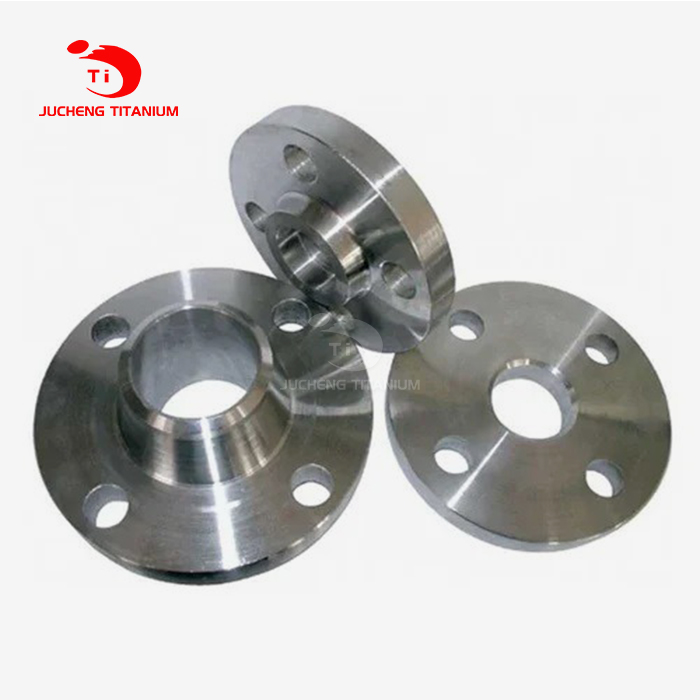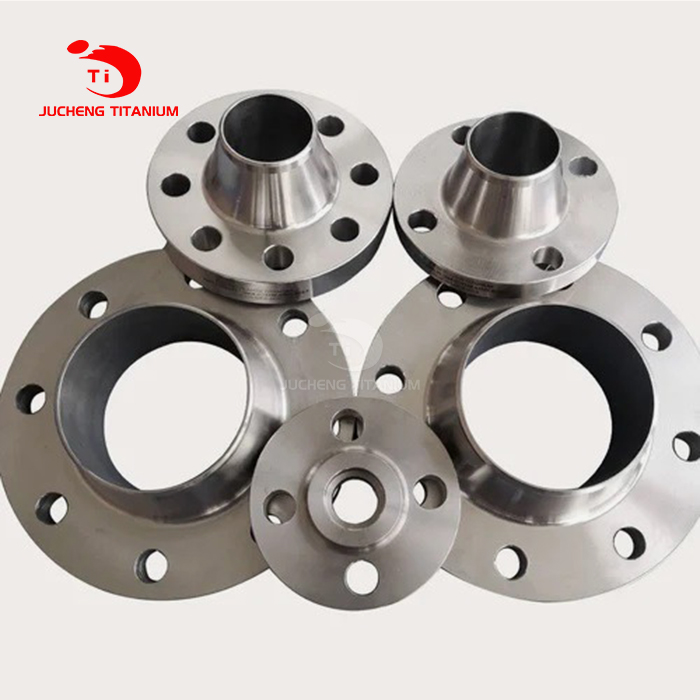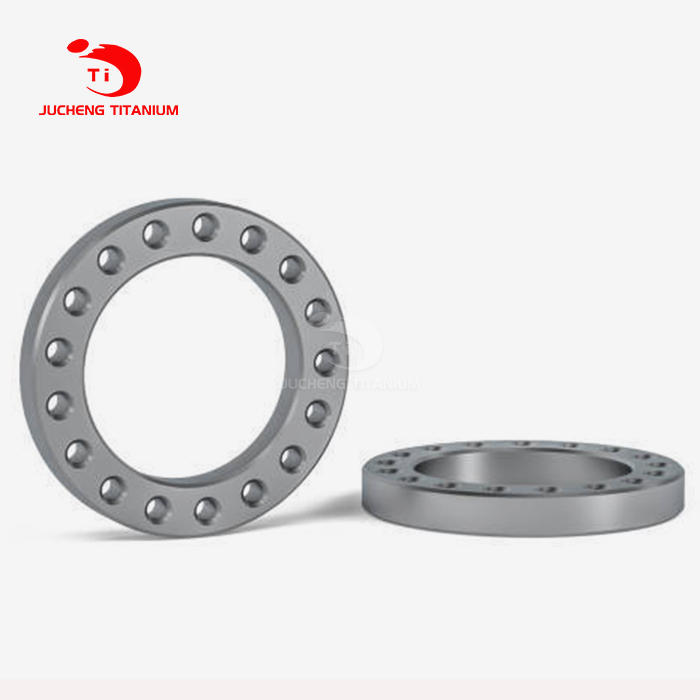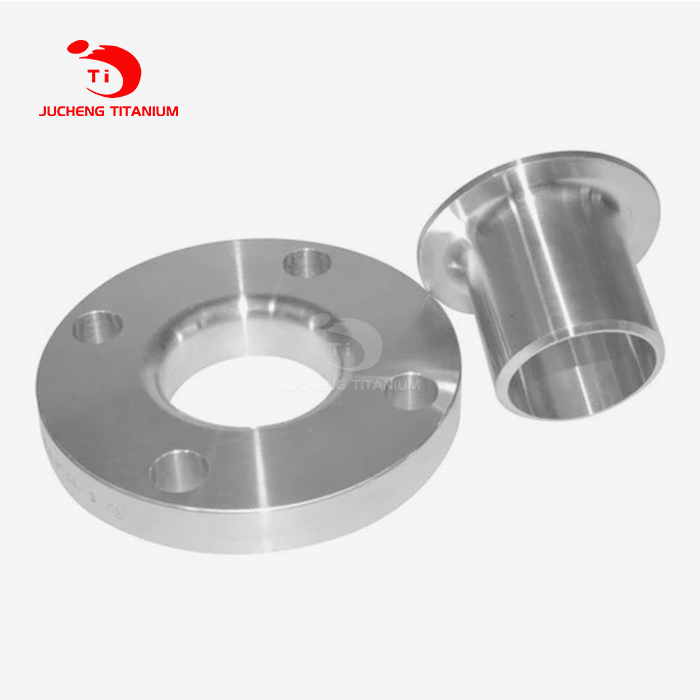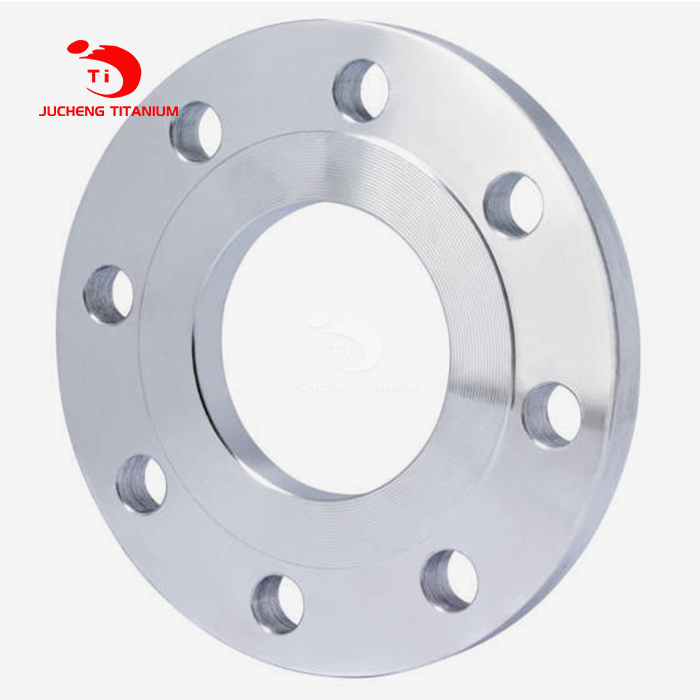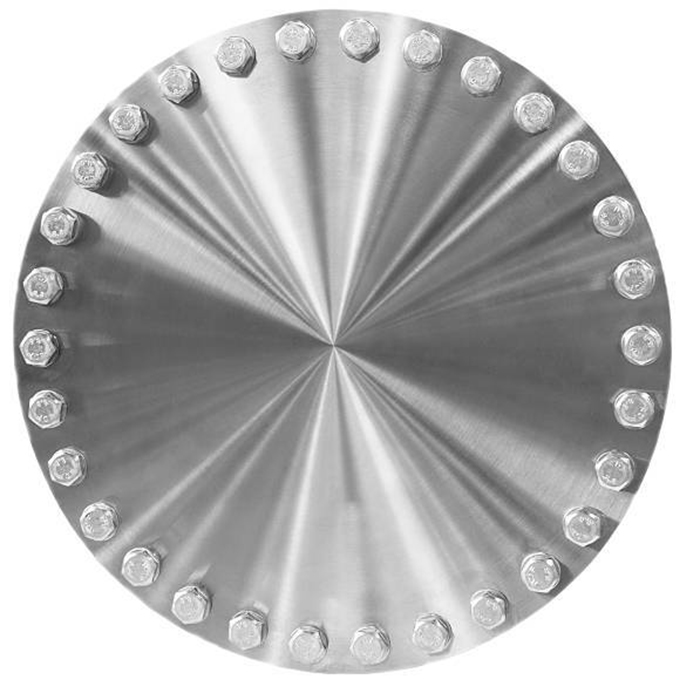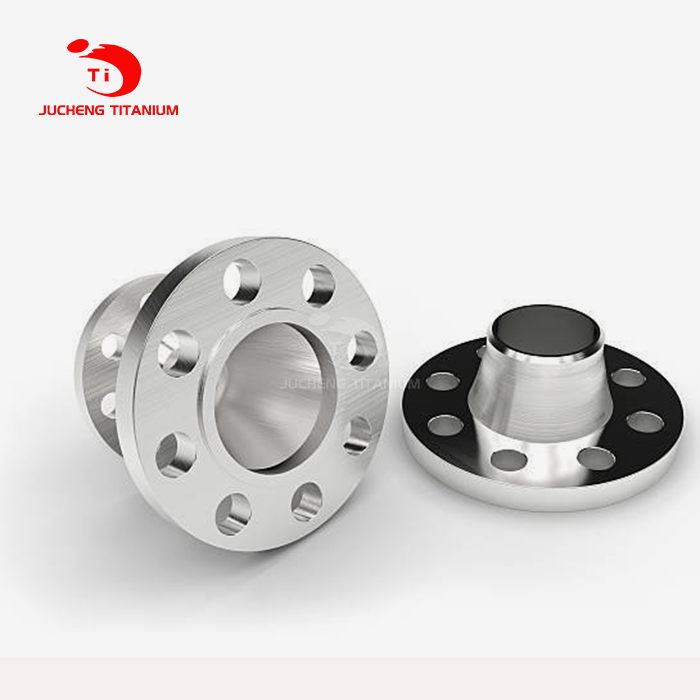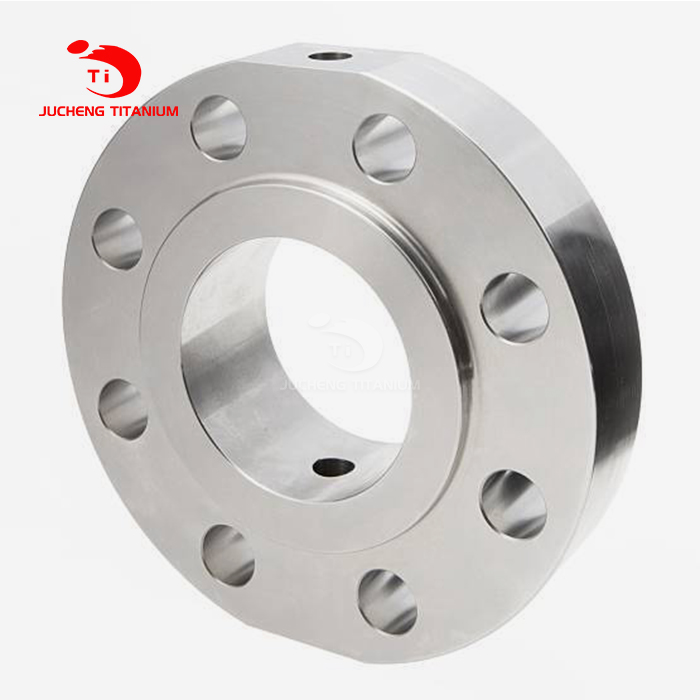

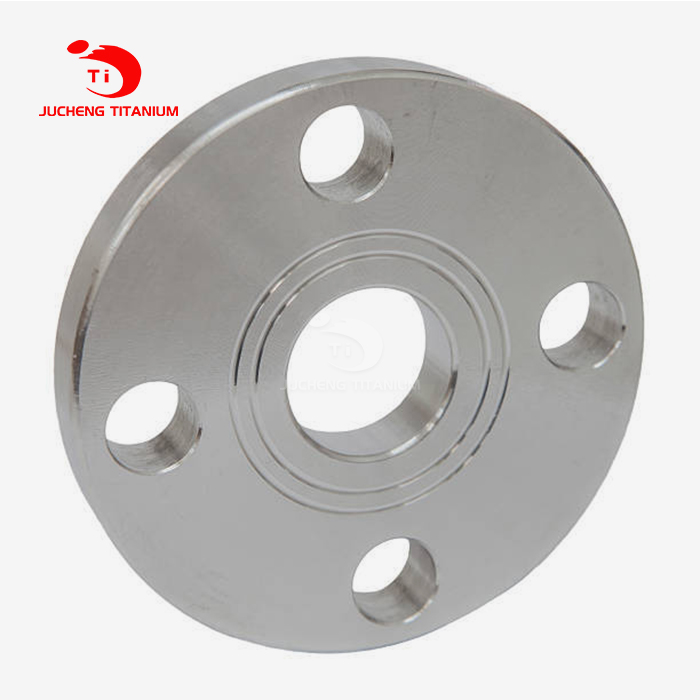
titanium alloy flange
2.Size: NPS 1/2″ – 48″ (DN15 – DN1200), custom larger sizes available, Thickness: Sch5S – Sch160, XXS
3.Standard: ASME/ANSI B16.5, ASME B16.47, MSS SP-44, DIN 2631-2638, EN 1092-1, AWWA C207, JIS B2220, GB/T 9112, HG/T 20592
4.Type: Weld Neck (WN), Slip-On (SO), Blind (BL), Socket Weld (SW), Threaded (THR), Lap Joint (LJ), Plate, Orifice, Long Weld Neck
5. Processing Method: Titanium ingot → Forging → Heat treatment → CNC machining → Drilling → Surface finishing → Marking
6.State: Annealed
7.Surface Treatment: Machined bright
- Product Description
Titanium Alloy Flange – Premium Corrosion-Resistant Piping Solution
Baoji Jucheng Titanium Industry Co., Ltd. has been producing high-performance titanium alloy flange components for demanding industrial environments for more than 20 years. Our year-round stockpile of over 3,000 tons of titanium materials allows us to produce over 500 pieces of titanium equipment each year. In accordance with ASME B16.5, EN 1092-1, and GB/T 9112 requirements, each flange is subjected to precision forging, CNC machining, and stringent quality inspection. Our flanges, which are available in a number of grades, including Gr2, Gr5 (Ti-6Al-4V), and Gr7, offer exceptional strength-to-weight ratios—they are 45% lighter than steel—and superior corrosion resistance in acidic, salty, and chloride-rich environments, where conventional materials are inadequate.
 |  |  |  |
Product Specifications
Parameter | Details |
Grade | Gr1, Gr2, Gr5 (Ti-6Al-4V), Gr7, Gr9, Gr12, Gr23 (Ti-6Al-4V ELI) |
Size Range | NPS 1/2″ – 48″ (DN15 – DN1200), custom larger sizes available |
Thickness | Sch5S – Sch160, XXS |
Standard | ASME/ANSI B16.5, ASME B16.47, MSS SP-44, DIN 2631-2638, EN 1092-1, AWWA C207, JIS B2220, GB/T 9112, HG/T 20592 |
Flange Types | Weld Neck (WN), Slip-On (SO), Blind (BL), Socket Weld (SW), Threaded (THR), Lap Joint (LJ), Plate, Orifice, Long Weld Neck |
Processing | Titanium ingot → Forging → Heat treatment → CNC machining → Drilling → Surface finishing → Marking |
State | Annealed |
Surface Treatment | Machined bright finish |
Weight Advantage | Approximately 45% lighter than equivalent steel flanges (density: 4.51 g/cm³) |
 |  |  |
 |  |  |
Manufacturing Excellence
Every step of our titanium alloy flange production process incorporates cutting-edge quality control. Using X-ray fluorescence, Positive Material Identification (PMI) confirms the precise grade composition. Internal discontinuities are found via ultrasonic testing in accordance with ASTM B381. Perfect sealing surfaces with Ra 3.2-6.3 μm finish are guaranteed by dye penetrant inspection.
Protocols for heat treatment maximize toughness by optimizing grain structure. Dimensional correctness within stringent ASME B16.5 tolerances is guaranteed via CNC machining. Complete traceability to raw material certifications is provided by final marking.
Our standing as a National High-Tech Enterprise and Specialized "Little Giant" is reflected in our quality management system, which has been approved by strict industry standards. With 41 utility model patents and 4 invention patents, our technological advancements consistently boost product dependability.
 |  |  |  |
Industry Applications
Marine Engineering: Seawater piping systems, desalination plants, offshore platform connections
Chemical Processing: Chlor-alkali plants, acidic media handling, reactor vessel connections
Aerospace: Hydraulic systems, fuel line connections, lightweight structural assemblies
Medical Equipment: Pharmaceutical processing, sterile fluid systems, biocompatible connections
Power Generation: Condenser systems, cooling water circuits, corrosive exhaust applications
 |  |  |
 |  |  |
Why Choose Our Titanium Alloy Flange
Superior Resistance to Corrosion
Seawater, moist chlorine, and organic acids are persistent threats to your plumbing system. Our flangeS creates a self-healing layer of TiO2 oxide that protects against pitting and stress corrosion. The expensive replacement cycles that are typical of stainless steel in chemical processing and maritime settings are eliminated by this passive protection.
Better Strength-to-Weight Results
When you need to reduce structural load without compromising pressure ratings, titanium works effectively. Grade 5 flanges have tensile strengths higher than 895 MPa while maintaining the critical 45% weight reduction. In aircraft applications, offshore platforms, and high-purity pharmaceutical systems, every kilogram matters.
Extended Range of Temperatures
The conditions of your process differ significantly. From continuous service at 315°C to cryogenic temperatures as low as -253°C, our flanges retain their structural integrity. While Grade 7's palladium additive guarantees performance in the most severe crevice corrosion conditions, Grade 2 delivers exceptional ductility for thermal cycling.
Quick Delivery & Personalization
We do away with the lengthy lead times that interfere with your project timelines thanks to our 3,000 tons of titanium inventory and full in-house forging capabilities. With the support of our 183-mu industrial park infrastructure, custom specifications, non-standard dimensions, and exceptional pressure class needs are made in shorter timeframes.

FAQ
Q: Is it possible to weld titanium flanges to stainless steel pipes?
A: No, direct welding produces brittle intermetallic complexes (FeTi) that break easily. When switching between materials, you have to use mechanical connections like V-band clamps or certain loose-flange designs with different gaskets.
Q: For high-strength applications, what grade should I specify?
A: For high-pressure systems and applications needing maximum bolt load resistance, Grade 5 (Ti-6Al-4V) offers the highest tensile strength at about 895 MPa. For welded connections and heat cycle conditions, Grade 2 provides exceptional ductility.
Q: How can bolt galling on titanium flanges be avoided?
A: Particular prevention is necessary due to titanium's propensity to gall. All threaded connections should be treated with high-temperature nickel-based anti-seize lubricant. As an alternative, couple Inconel studs with stainless steel nuts to reduce seizing by creating a different material pairing.
Q: What is the reason of color changes in titanium flanges?
A: Natural oxidation creates temperature-dependent color zones, which are blue above 500°C, purple at 400°C, and gold at 300°C. This thermal patina displays patterns of heat exposure and confirms that the material is genuine titanium. Corrosion resistance and structural integrity are unaffected.
Q: Is it necessary to utilize specific gasket materials for titanium flanges?
A: Yes. Use spiral-wound gaskets made for titanium's reduced modulus of elasticity, expanded graphite, or PTFE. Long-term seal integrity is ensured by carefully chosen gaskets and regulated bolt torque sequences that stop leaks.
Contact Us for Technical Solutionss4@juchengti.com
Our engineering team provides customized titanium alloy flange specifications, material selection guidance, and complete system integration support. For technical questions, quotes, or requests for expedited delivery, contact our experts at s4@juchengti.com. Let our more than 20 years of experience with titanium handle your most difficult corrosion and weight-reduction needs right now.