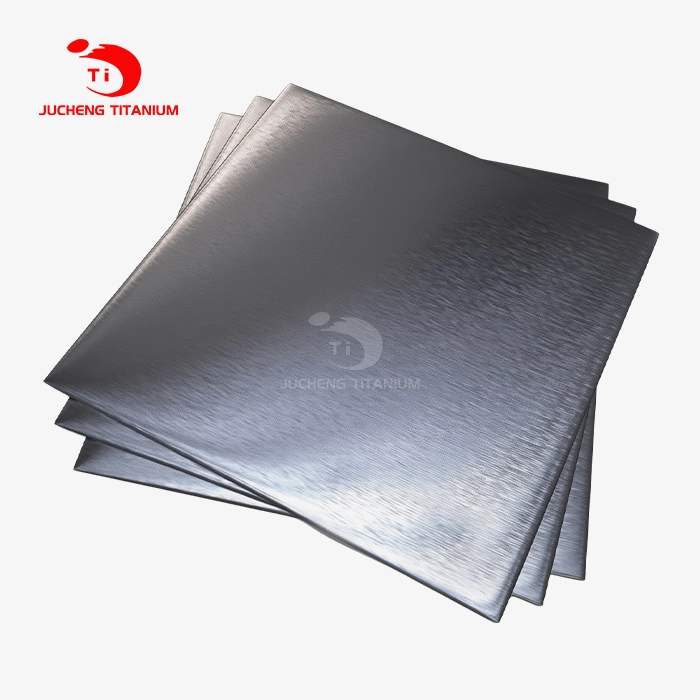

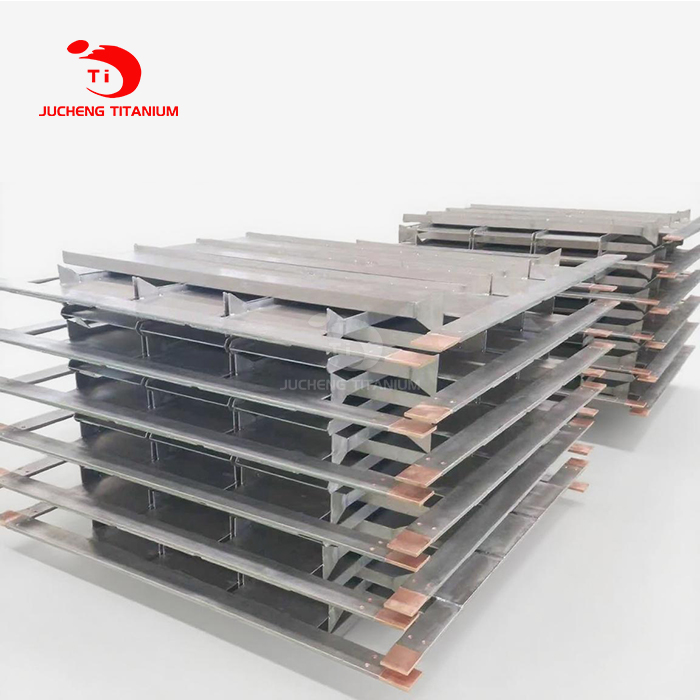
Titanium Cathode Plate
2.Size:
- Thickness: 2 – 25 mm
- Width: 500 – 1500 mm
- Length: 1000 – 4000 mm
- Fully customizable
3.Standard: ASTM B265, ASTM F67, GB/T 3621, YS/T 1261
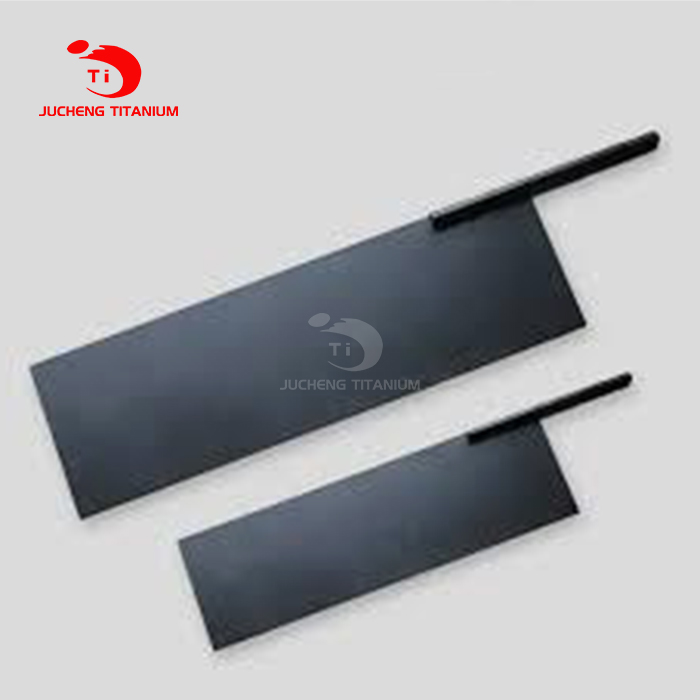
4.Type: Flat seed plate, Seed plate with hanger bar (V-groove or welded)
5.Processing Method: VAR melting → Forging → Hot rolling → Multiple annealing → Precision leveling → CNC machining of hanger bar → Final polishing
6.State: Annealed
7.Surface Treatment: polished, Pickled, Sandblasted
- Product Description
Titanium Cathode Plate: Industrial-Grade Electrowinning Solution
Baoji Jucheng Titanium Industry Co., Ltd. manufactures precision-engineered Titanium Cathode Plate for electrochemical applications, utilizing cutting-edge VAR melting technology and more than 20 years of titanium knowledge. Our cathode plates are totally configurable to fit certain cell layouts and come in Gr1 and Gr2 grades with thicknesses between 2 and 25 mm, widths between 500 and 1500 mm, and lengths between 1000 and 4000 mm. Each plate is produced using a strict method that guarantees consistent current distribution and a longer service life. This process includes VAR melting, forging, hot rolling, numerous annealing cycles, precise leveling, CNC hanger bar machining, and final polishing. We ensure quick delivery and a steady supply for large-scale electrowinning operations with an annual inventory of about 3,000 tons and a production capacity surpassing 500 equipment sets.
 |  |  |  |
Extended Operational Lifespan
Field data from mining operations demonstrates cathode plate service life exceeding 10 years. The annealed state combined with polished, pickled, or sandblasted surface treatments minimizes dendrite adhesion during metal deposition.
Corrosion resistance in chloride-rich brines and sulfuric acid concentrations up to 200 g/L remains uncompromised. This eliminates the frequent replacement cycles that plague copper-based systems.
Our quality control team—backed by 4 invention patents and 41 utility model patents—monitors oxygen and iron interstitial content to maintain ductility without sacrificing strength.
Technical Specifications
Parameter | Details |
Grade | Gr1, Gr2 |
Thickness | 2 – 25 mm |
Width | 500 – 1500 mm |
Length | 1000 – 4000 mm |
Standards | ASTM B265, ASTM F67, GB/T 3621, YS/T 1261 |
Type | Flat seed plate; Seed plate with hanger bar (V-groove/welded) |
Processing | VAR melting → Forging → Hot rolling → Multiple annealing → Precision leveling → CNC machining → Polishing |
State | Annealed |
Surface Treatment | Polished, Pickled, Sandblasted |
Customization | Fully customizable dimensions and configurations |
 |  |  |
 |  |  |
 |  |  |  |
Industry Applications
Copper Electrowinning Operations
Solvent extraction-electrowinning (SX-EW) facilities processing copper-bearing leach solutions utilize our cathode plates for permanent cathode systems. The material withstands organic phase contamination from extractants that degrade alternative metals.
Zinc Refining Processes
In jarosite and goethite precipitation circuits, Titanium Cathode Plate resists attack from ferric ion impurities. The smooth surface finish facilitates mechanical stripping, reducing labor costs in high-throughput refineries.
Precious Metal Recovery
Electrorefining operations for gold, silver, and PGM recovery benefit from the non-contaminating nature of titanium. Unlike graphite anodes that shed particles, our plates maintain electrolyte purity critical for high-grade metal production.
 |  |  |
 |  |  |
Why Choose Our Titanium Cathode Plate
Superior Electrochemical Performance
Our cathode plates solve the critical "Current Efficiency Dilemma" in hydrometallurgical operations. Traditional copper cathodes suffer rapid dissolution in acidic electrolytes, contaminating solutions and increasing maintenance frequency.
The titanium substrate provides exceptional passivation. Its native oxide layer remains stable in pH ranges below 1, maintaining structural integrity where stainless steel fails.
The plates exhibit minimal voltage drop during high-amperage operation. This directly reduces energy consumption by 15-25% compared to conventional materials in copper and zinc electrowinning applications.

Frequently Asked Questions
Q: What is the typical lead time for custom-sized cathode plates?
A: Standard configurations ship within 7-15 days from our 3,000-ton inventory. Custom dimensions require 25-35 days depending on complexity, with expedited processing available for urgent projects through our 900 million RMB industrial park facilities.
Q: Can your plates withstand reverse polarity conditions?
A: Yes. The passivation layer regenerates automatically even after anodic polarization events. However, prolonged reverse current above 500 A/m² may accelerate surface oxidation and should be avoided in cell design.
Q: How do you ensure hanger bar weld integrity?
A: We employ argon-shielded TIG welding with titanium filler rods matching the base grade. Each weld undergoes ultrasonic testing per ASTM E213 to detect porosity or lack of fusion that could cause mechanical failure during handling.
Q: What surface treatment do you recommend for high-purity applications?
A: Electropolished surfaces minimize surface area and contamination risk. For operations prioritizing dendrite release, we suggest mechanical polishing to Ra 0.4 μm combined with passivation in 20% nitric acid solution.
Q: Do you provide technical support for cell design integration?
A: Our R&D team—collaborating with Northwest Nonferrous Metals Research Institute and Tsinghua University—offers consultation on current density optimization, spacing calculations, and cathode positioning for maximum current efficiency in your specific electrolyte chemistry.
Partner With Titanium Experts
Baoji Jucheng Titanium delivers industrial-grade Titanium Cathode Plate solutions backed by NEEQ listing credibility and National High-Tech Enterprise certification. Contact our technical team at s4@juchengti.com to discuss your electrowinning requirements and receive customized recommendations.