



CP grade 4 titanium sheet cold rolling and pickling process
The CP grade 4 titanium sheet cold rolling and pickling process defines the surface integrity and mechanical performance of the highest-strength commercially pure titanium grade available. Through controlled cold reduction and acid treatment, manufacturers achieve consistent thickness, a clean oxide-free surface, and verified corrosion resistance—all critical for aerospace, chemical, and medical procurement. Understanding this process helps buyers evaluate supplier capability, confirm compliance with ASTM B265 and AMS 4911, and make informed sourcing decisions before placing long-term orders.
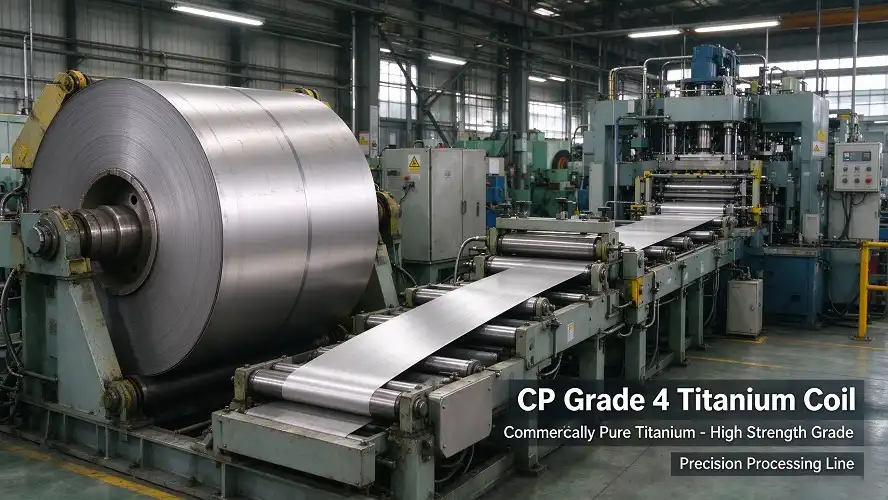
Understanding CP Grade 4 Titanium Sheet and Its Key Properties
Grade 4 titanium is the best titanium that can be bought right now. What makes it different from softer grades is that its properties come from a chemical makeup that has been carefully controlled.
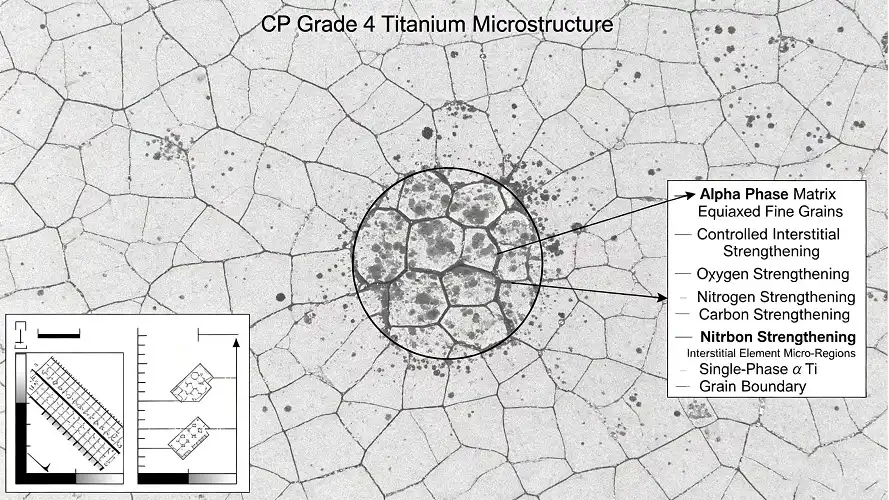
Chemical Composition and What It Means
That's up to 0.40 weight percent more oxygen and 0.50 weight percent more iron than Grades 1, 2, or 3. These interstitial elements make the alpha-phase matrix stronger, and they do this without adding any alloying elements. The reason why alloys like Ti-6Al-4V (Grade 5) are listed separately from Grade 4 metals in ASTM B265 and ASTM F67 is that Grade 4 metals can't have as many different parts.
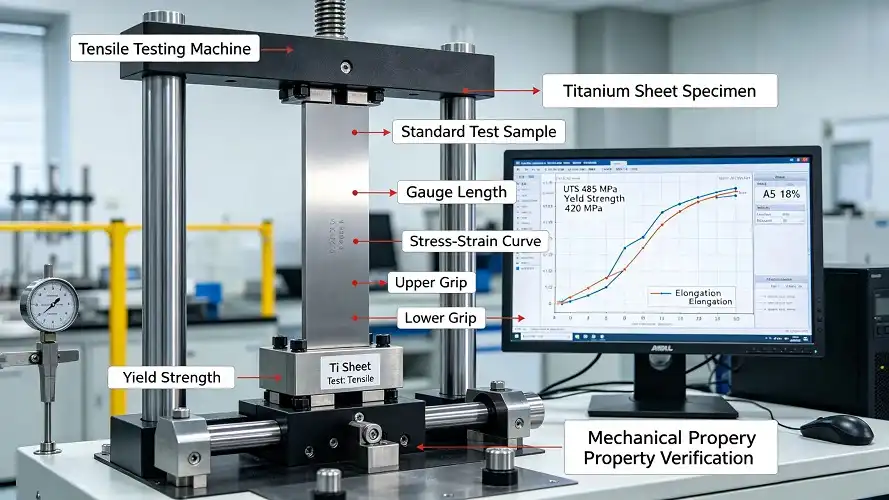
Mechanical Performance at a Glance
- The UTS is usually higher than the minimum of 550 MPa (80 ksi) in cold-rolled sheets.
- The least amount of bending strength that is needed is 480 MPa (70 ksi).
- Tensile strength: at least 15%, which shows that the material is flexible even though it is strong.
- The density is 4.51 grams per cubic centimetre, which means it has a great amount of strength to weight.
These numbers are important for engineers who work in space and for those who build chemical plants because they can't let things fall down.
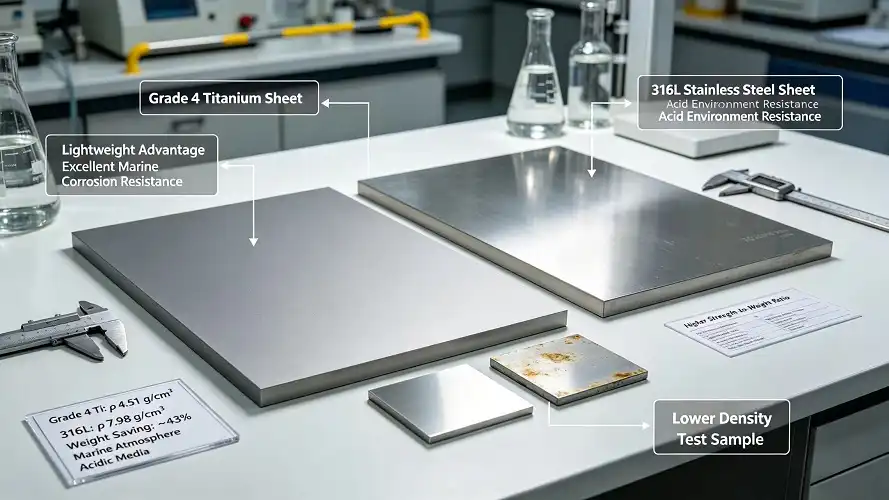
Why Grade 4 Outperforms Alternative Metals
At the same width, a sheet of Grade 4 titanium weighs about 43% less than a sheet of 316L stainless steel. It doesn't rust as easily as metal does when it comes into contact with salt and acidic conditions. Grade 4 can keep its mechanical qualities at temperatures of up to 425 degrees Celsius (800 degrees Fahrenheit), which is something that metal can't do.
The Cold Rolling Process for CP Grade 4 Titanium Sheet
The microstructure of the hot-rolled titanium strip is fine-tuned, and the strip's dimensions are made more accurate during the cold rolling process. This process, which isn't just meant to make the sheet thinner, has a direct effect on the fatigue strength and surface condition of the sheet.
Key Process Parameters
About 20% to 40% of the titanium in Grade 4 is lost during each cold-rolling pass for CP grade 4 titanium sheet. Because Grade 4 has more oxygen than Grade 2, it is harder to shape, so the rolling speed and inter-pass heating temperatures need to be carefully adjusted. Intermediate annealing at about 700–800°C makes the metal workable again between passes.
Common Challenges and How They Are Managed
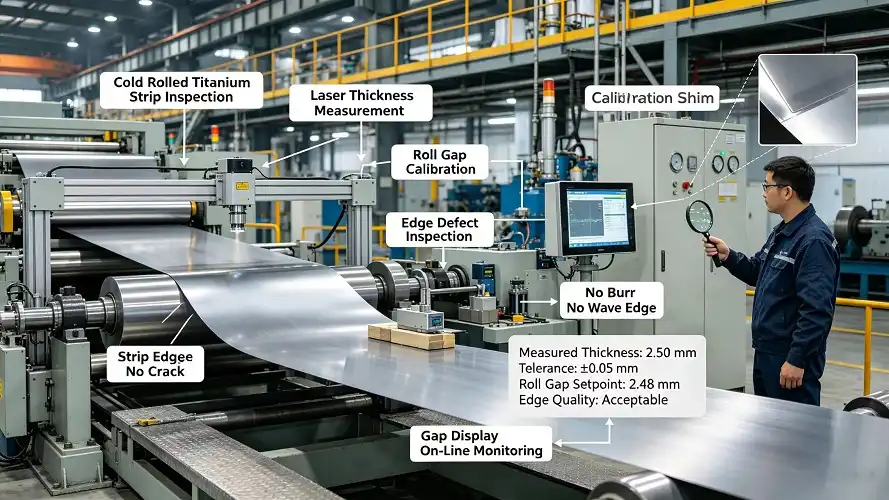
The fissures that appear around the margins and the uneven breadth are the most typical complications. In order to maintain these faults below the thresholds that lead to rejection, it is necessary to have accurate roll alignment, constant lubrication, and real-time thickness monitoring using automated gauge control systems. Those suppliers that maintain ISO certification for their process controls are able to identify and correct errors before they reach the final coil.
How Cold Rolling Improves Final Sheet Quality
Cold-worked Grade 4 sheet has a higher wear limit and a more polished alpha-grain structure than hot-rolled material. This is in comparison to the material that is hot-rolled. When acquiring a sheet that satisfies the criteria of ASTM B265 or AMS 4911, cold rolling is the sole method that can be used to get the more stringent thickness tolerance bands (typically ±0.05 mm at 1.0 mm gauge) that are essential for precision production.
The Pickling Process: Enhancing Surface Quality and Corrosion Resistance
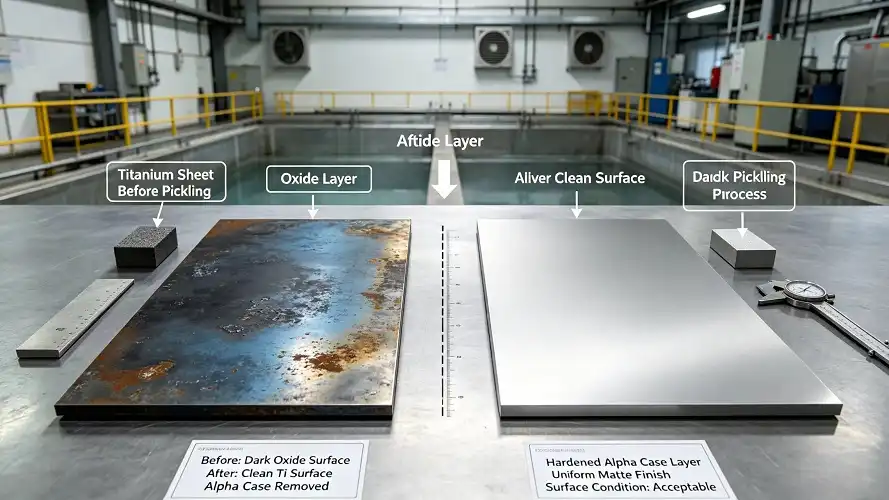
A mixed oxide scale and a putative "alpha case" are both present in titanium sheet after it has been heated and cold rolled. The "alpha case" is a layer that grows on the surface throughout heat treatment. It is brittle and has a high concentration of oxygen. To eliminate both, pickling is used.
The Acid Solution and Safe Handling
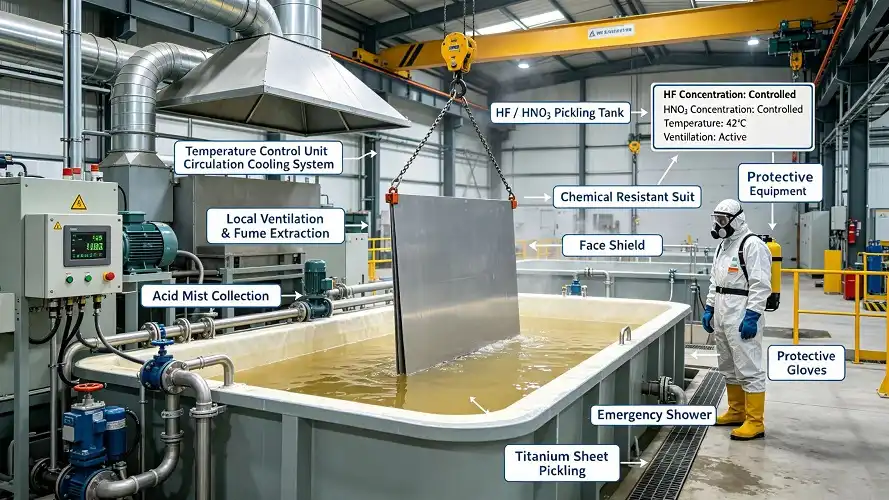
In a conventional pickling bath, a mixture of hydrofluoric acid (HF, 2–5%) and nitric acid (HNO3, 30%) is combined. Nitric acid is responsible for the breakdown of dissolved titanium ions and prevents hydrogen from weakening the metal. Hydrofluoric acid (HF) is responsible for removing oxide scale. Both temperature control (often between 20 and 40 degrees Celsius) and stringent regulations for personal protective equipment (PPE) must be adhered to in order to ensure the safety of workers and achieve consistent outcomes.
Step-by-Step Pickling Sequence
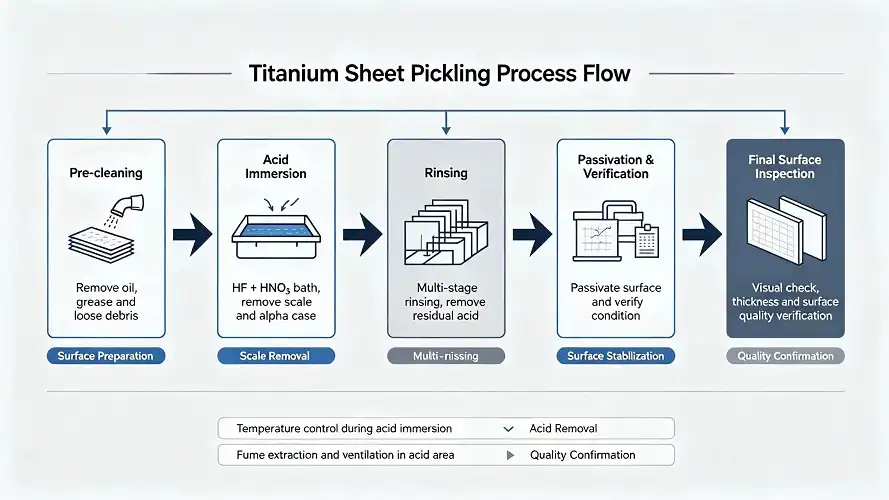
All of the phases in the process are easy to understand and safeguard not only the materials but also the workers:
- During the pre-cleaning process, rolling lubricants and surface oils are removed using alkaline degreasing.
- The sheets are submerged in the HF/HNO3 solution for a predetermined amount of time, which may range anywhere from five to fifteen minutes per sheet, depending on the thickness of the oxide.
- Rinsing with water — The several phases of the cascade rinse process neutralise any remaining acid.
- Check for passivation: The passive titania coating will renew on its own; corrosion testing will verify that it is intact.
- The final examination, which may include ultrasonic testing or dye penetrant inspection (DPI), verifies that the surface is free of any defects.
Post-Pickling Quality Verification
Sheets are chemically analyzed according to ASTM E120/E1941 after being pickled to make sure the amounts of oxygen and iron are correct. Testing for bends according to ASTM E290 at a radius of 2.5T to 3T shows that removing the alpha case did not leave any brittleness behind. The mill only sends out sheets that pass all of its checks.
Comparative Analysis: CP Grade 4 Titanium Sheet Versus Other Materials
Buyers sometimes wonder if Grade 2 is good enough or if Grade 5 is needed. The answer depends on the load and the environment where corrosion is happening.
Grade 4 vs. Grade 2
The UTS for Grade 2 is only 345 MPa, while the UTS for Grade 4 is 550 MPa for CP grade 4 titanium sheet. Grade 2 might not have enough structural room for chemical reactor liners or high-pressure heat exchanger tube sheets that work in wet chlorine environments. While Grade 4 doesn't have as much rust resistance as commercially pure titanium, it does fill in the gap. The downside is that it is less easy to shape; bend radii of at least 3T are suggested to keep the material from cracking.
Grade 4 vs. Grade 5 (Ti-6Al-4V)
In spite of the fact that Grade 5 is more robust (with a UTS of around 950 MPa), it is much more costly and requires more intricate cutting. Grade 4 is indicated for use in locations that need total corrosion resistance, such as offshore desalination, wet chlorine service, or body-implant contact. This is due to the fact that Ti-6Al-4V includes vanadium, which raises biocompatibility problems according to ASTM F67.
Grade 4 vs. Stainless Steel
When the chloride levels in the water exceed around 200 parts per million, 316L stainless steel begins to deteriorate. This is the case for deep-sea systems that are used to transport objects or portions of desalination plants that have been harmed by saltwater erosion and rust. In the case of grade 4 titanium sheet, this is not the case. Titanium is often more than able to compensate for its greater initial cost due to its longer service life and lesser demand for replacement requirements.
Procurement Insights: Buying CP Grade 4 Titanium Sheet Efficiently
When you buy the Grade 4 sheet from a seller with a good name, you lower both the cost risk and the time you have to wait. When you place an order, these are the things that are most important to you.
Product Specifications to Confirm
Before you ask the seller for a price, make sure they can meet your needs. From Jucheng Titanium, you can choose from different grades, such as Gr1, Gr2, Gr4, Gr5, Gr7, Gr9, and Gr12. Plates can be anywhere from 4 mm to 80 mm thick, 950 mm to 2,500 mm wide, and up to 10,000 mm long (or custom-made). Metal can be worked on in a number of ways, such as by rolling, heating, levelling, pickling, and finishing the surface. Finishing the surface is another way to do it. The skin of the item can be machined, polished, or pickled in acid. The following standards can be used: ASTM B265, ASTM F67, AMS 4911, and ASME SB265.
Certification and Traceability Requirements
Buyers in the medical and aircraft industries should demand full material traceability, which includes mill test reports (MTRs), heat number records, and proof that the product has been checked by a third party. AS9100 and FDA audit standards say that suppliers must be certified to the ISO 9001 standard and approved by national high-tech business programs in order to meet their needs. These sellers offer a great method that has been documented.
Logistics and Lead Time Planning
While the year goes on, Jucheng Titanium keeps an inventory of about 3,000 tonnes of titanium, which lets them quickly meet regular needs. If you work with the supplier's technical team early on, you can add custom thickness tolerances, surface treatments, or small-batch experimental specs to the production schedule. By doing this, you will avoid having to pay extra for faster shipping.
Conclusion
Hot-rolled Grade 4 titanium coil is turned into a clean, exactly measured CP grade 4 titanium sheet that is ready for use in aircraft, chemicals, and medicine through a process called cold rolling and pickling. From inter-pass annealing to the final DPI inspection, every step of the process has a direct effect on whether the finished sheet meets the requirements of ASTM B265, AMS 4911, or ASTM F67. If you are a buying worker, knowing what goes on inside the mill will help you ask the right questions, judge the skills of potential suppliers, and lower the risk in the supply chain for your next titanium project.
FAQ
1. How does cold rolling change the strength of Grade 4 titanium sheet?
The material is made stronger and its alpha-grain structure is smoothed out by cold rolling. This raises the limit for wear and makes the thickness standards tighter. The sheet still meets the 15% elongation minimum required by ASTM B265 after going through intermediate annealing cycles that make it flexible again.
2. What makes the pickling process necessary after annealing?
When you anneal something at high temperatures, you make an oxide scale and a brittle alpha-case layer on the surface. If this layer is left in place, it causes cracks to appear too soon when the metal is bent or formed. Pickling in an HF/HNO₁ bath removes both layers and lets the passive titania film form again, which restores the metal's full resistance to rust.
3. What certifications should I require from a Grade 4 titanium sheet supplier?
At the very least, you should ask for mill test reports, tensile test data according to ASTM E8, and a bend test record according to ASTM E290. For medical uses, you need to be certified to ASTM F67.
4. Can Grade 4 sheet be used for surgical implants?
Yes. Grade 4 titanium is biocompatible and helps bone integrate, even though it is very strong. It is often used for tooth implants and bone pins when Grade 2's lower strength is not enough.
Request a Quote from Jucheng Titanium — Your Trusted CP Grade 4 Titanium Sheet Supplier
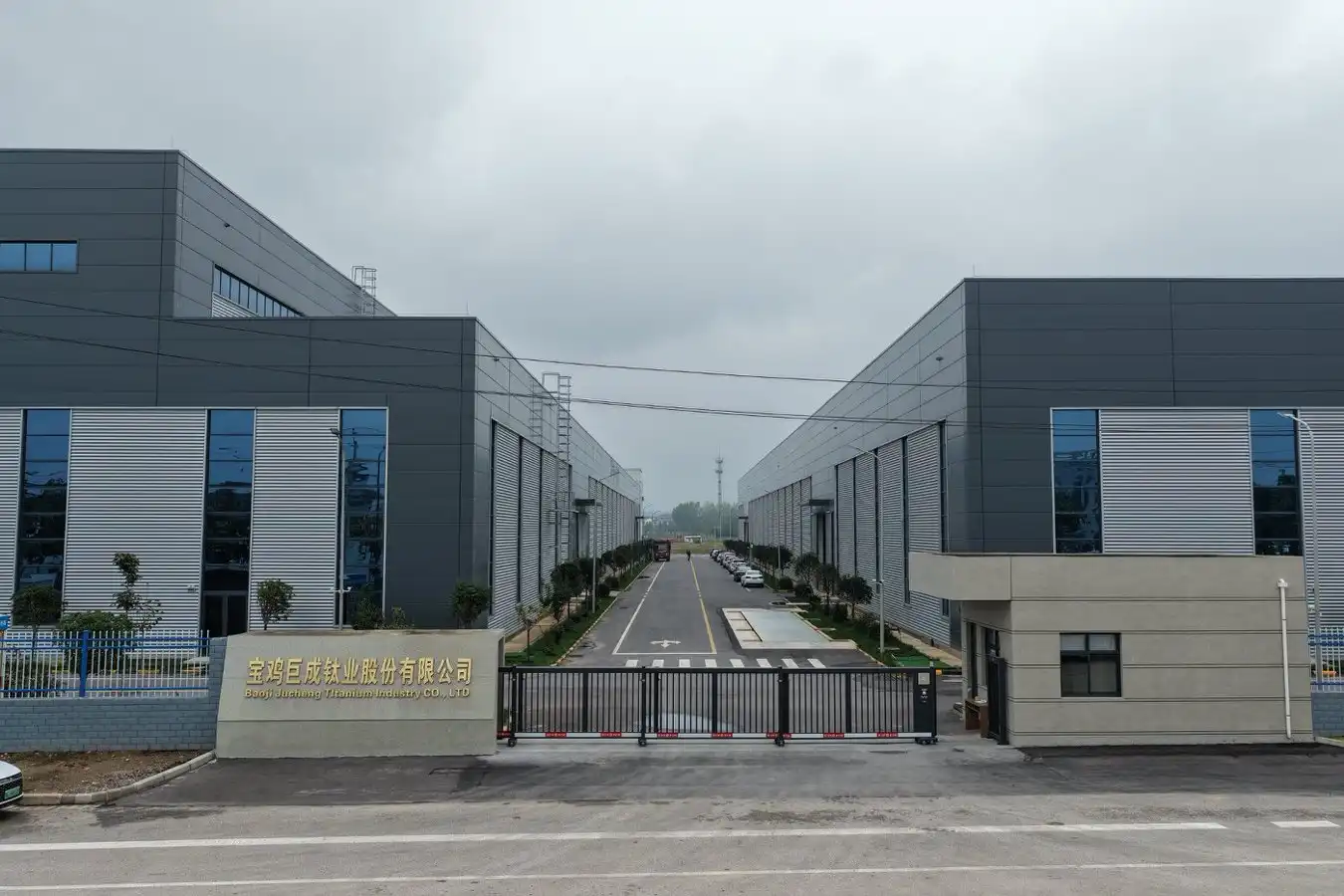
Jucheng Titanium has been supplying certified CP grade 4 titanium sheet from Baoji, China's titanium production center, for more than 20 years. They have 4 patents and keep 3,000 tons of stock on hand to ensure quick delivery. For a very important project, our technical team is ready to help you whether you need acid-pickled Grade 4 sheet to ASTM B265 or custom sizes. You can email us at s4@juchengti.com to talk about your needs right away.
References
1. ASTM International. ASTM B265: Standard Specification for Titanium and Titanium Alloy Strip, Sheet, and Plate. ASTM International, 2020.
2. ASTM International. ASTM F67: Standard Specification for Unalloyed Titanium for Surgical Implant Applications. ASTM International, 2019.
3. SAE International. AMS 4911: Titanium Alloy Sheet, Strip, and Plate. SAE International, 2021.
4. Boyer, R., Welsch, G., & Collings, E. W. Materials Properties Handbook: Titanium Alloys. ASM International, 1994.
5. Donachie, M. J. Titanium: A Technical Guide, 2nd ed. ASM International, 2000.
6. Rack, H. J., & Qazi, J. I. "Titanium alloys for biomedical applications." Materials Science and Engineering: C, Vol. 26, Issues 8–9, 2006, pp. 1269–1277.