



How to choose Gr9 titanium plate for bicycle and marine use
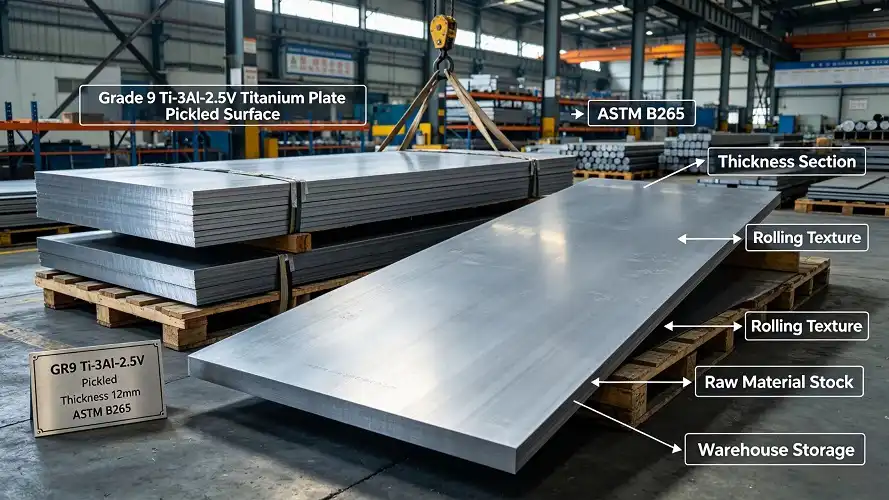

Choosing the right titanium plate is not always straightforward, especially when your application demands both structural performance and long-term corrosion resistance. If you work in bicycle frame manufacturing or marine component production, the Ti-3Al-2.5V alloy — commonly called Gr9 titanium plate — offers a practical answer. With a tensile strength of ≥620 MPa, outstanding cold formability, and near-identical seawater resistance to commercially pure titanium, it consistently outperforms stainless steel and many competing alloys on a weight-adjusted basis. This guide walks through everything a procurement engineer or materials buyer needs to evaluate before placing an order.
Understanding Gr9 Titanium Plate: Properties and Advantages
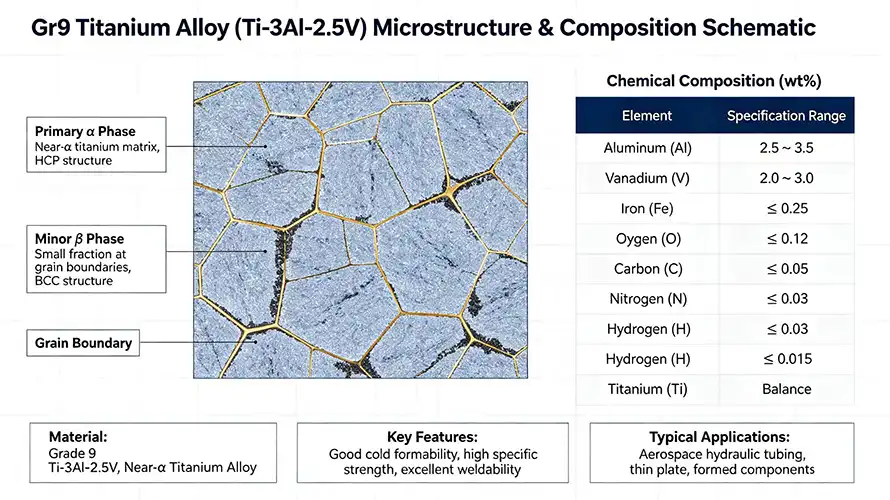
What Is Ti-3Al-2.5V?
The UNS R56320 classification says that Gr9 is a near-alpha, alpha-beta metal with 3% aluminum and 2.5% vanadium. People in the business world sometimes call it "Half 6-4" because it is made up of elements that are between commercially pure grades and Grade 5 (Ti-6Al-4V), which is stronger. Usually, it comes in the annealed state, having been hot rolled, leveled, and acid pickled. It meets ASTM B265, AMS 4911, and ASME SB265.
Mechanical and Physical Data
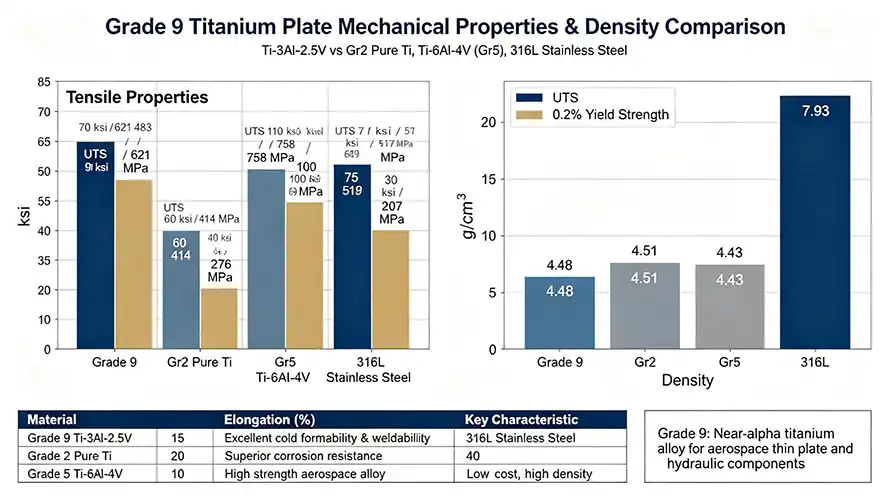
The metal has a mass of about 4.48 g/cm³ and a minimum yield strength of 483 MPa (70 ksi). That mix gives it a strength-to-weight ratio that stainless steel can't match for the same thickness. It melts at about 1670°C, and its resistance to oxidation stays good up to 315°C, which is enough for most biking and naval service conditions.
Cold Formability Advantage
In contrast to Grade 5, Gr9 can be cold-worked down to 75–85% before it needs to be annealed at 600–800°C. This means that manufacturers don't have to buy expensive hot-forming equipment to bend, stamp, or draw complicated frame geometries and bracket profiles. This makes the process much cheaper.
Comparing Gr9 Titanium Plate to Other Grades and MaterialsGr9 vs. Gr5 (Ti-6Al-4V)
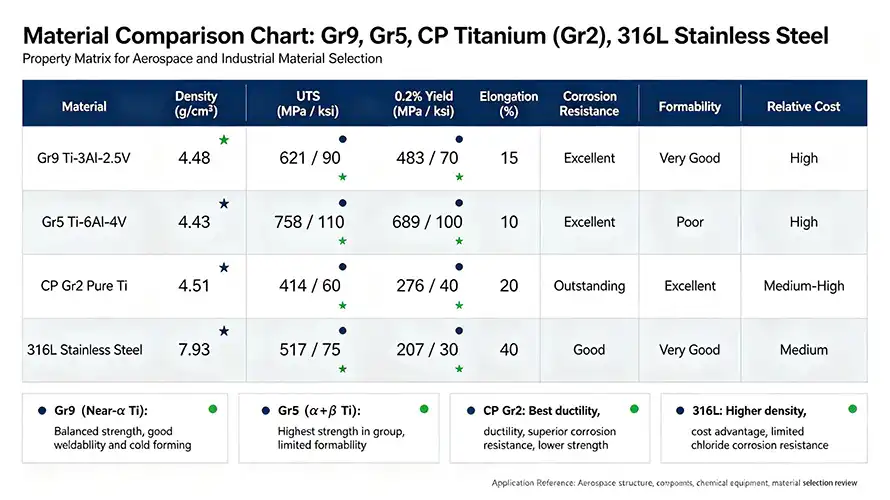
Grade 5 is about 20% harder than Grade 9, but most manufacturers have to machine or heat work it instead, which is more expensive. When it comes to bicycle tubing and naval hardware that needs to be bent in complicated ways, Gr9's better ductility and weldability directly lead to lower production costs and faster wait times.
Gr9 vs. Commercially Pure Grades (Gr1, Gr2)
In chemical environments, Grade 2 is the most common CP grade, but its tensile strength is only 345 MPa, which is about 45% less than Gr9. That gap is important when structural loads are present, like in bike frames and naval brackets. This performance range is covered by Gr9, which doesn't give up the corrosion resistance that CP grades are known for.
Gr9 vs. Stainless Steel
A 316L stainless steel plate weighs about 75% more than a Gr9 titanium plate of the same size but costs less per kilogram. In salty seawater, both stainless steel and titanium can rust in cracks and pits, but titanium naturally doesn't rust. Titanium often has a lower total cost of ownership over the course of a product's five to ten-year lifetime because it needs less upkeep and lasts longer.
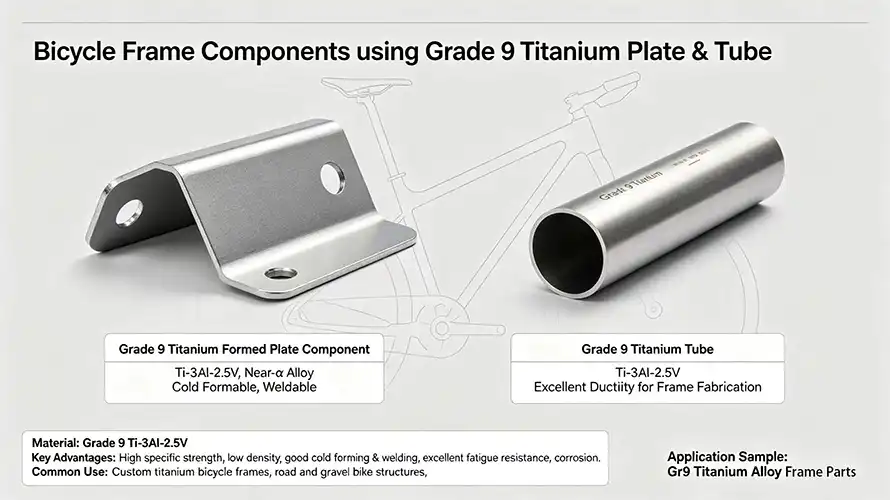
Critical Selection Criteria for Bicycle and Marine ApplicationsPlate Dimensions and Thickness Tolerances
Jucheng Titanium's standard hot-rolled Gr9 plate comes in thicknesses ranging from 4 mm to 80 mm, widths ranging from 950 mm to 2,500 mm, and lengths up to 10,000 mm. Custom sizes can be made upon request. Thinner gauges (4–10 mm) are usually needed for bicycle applications. Marine structural plates and heat exchanger parts, on the other hand, may need 20–50 mm sections.
Certification and Traceability Requirements
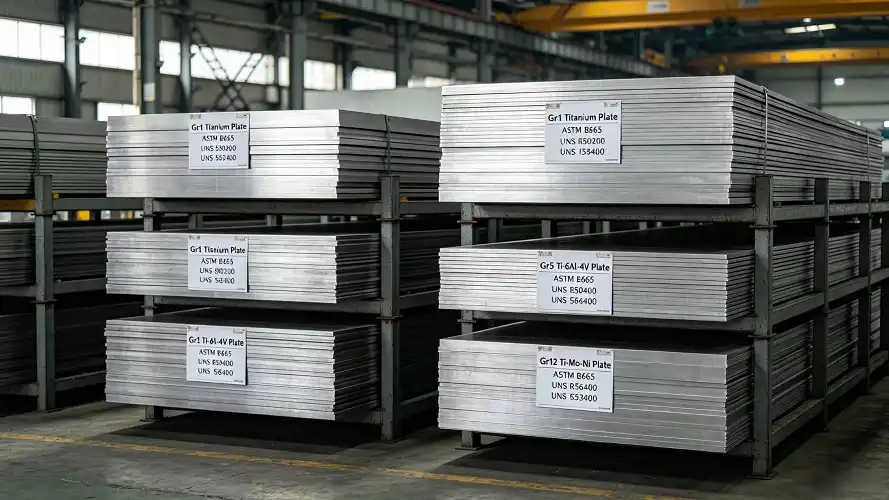
There should be material test reports (MTRs) on every plate that can be linked to the production heat. Some of the standards that are accepted are ASTM B265 for sheet and plate, ASTM F67 for implant-grade purity, AMS 4911 for use in spacecraft, and ASME SB265 for use in pressure vessels. By asking for certificates of conformance at the time of order, compliance problems can be avoided later on. This is especially true for customers who supply aerospace or defense programs.
Surface Treatment Options
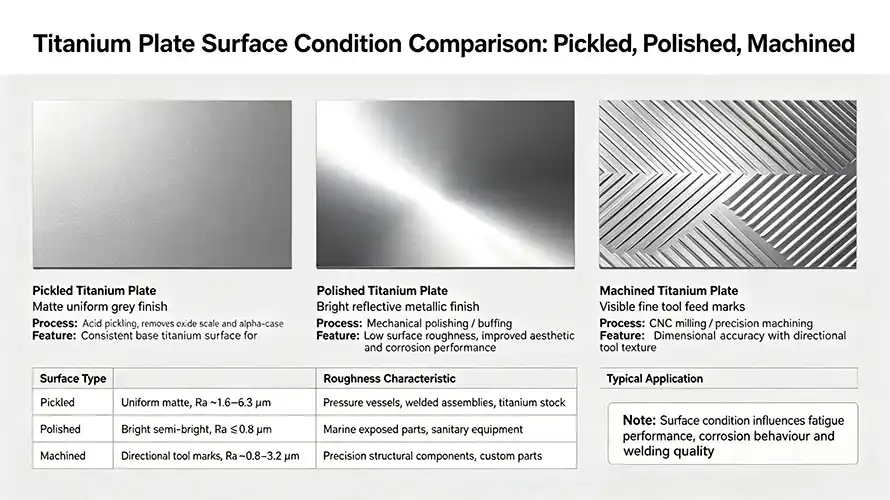
Both weld quality and fatigue life are affected by the condition of the surface. The Ti-3Al-2.5V plate can have these three main surface treatments:
- Acid Pickled: Removes the alpha case and surface oxides formed during rolling, producing a clean matte finish suitable for welding and further fabrication. This is the most common delivery condition for structural bicycle and marine parts.
- Polished: Provides a smooth, visually consistent surface often specified for medical-grade or consumer-facing components. Polished plates also reduce crevice corrosion risk in marine fittings.
- Machined: Used when tight dimensional tolerances are required, such as precision marine instrument housings or custom bicycle dropout plates.
By choosing the right surface treatment when the order is placed, you can avoid having to pay extra for secondary handling at your site.
How to Source High-Quality Gr9 Titanium PlatesEvaluating Supplier Qualifications
A good provider of Gr9 titanium plates should be ISO 9001 certified, have experience with export paperwork for goods going to other countries, and keep extra plates on hand in case of short-notice deliveries. Most of the world's titanium production is concentrated in Baoji, Shaanxi Province, which is also known as China's Titanium Valley. It is more likely that suppliers based there will have shorter mill wait times and better bulk prices than secondary distributors.
Quality Inspection Protocols to Request
Ask a provider for their standard review checklist before you give them the go-ahead. Reliable manufacturers check the chemical makeup using ICP or OES spectrometry, do ultrasonic testing (UT) according to AMS 2631 Class A1 to find internal flaws, and bend test to make sure the cold-forming works. It is better to avoid buying from a seller that can't show recorded UT results on aerospace- or marine-grade plate.
Wholesale Pricing and Minimum Order Quantities
When you buy a lot of titanium plates, the price per kilogram goes down. Many well-known Baoji manufacturers keep about 3,000 tons of titanium in stock all year, which makes it easy to meet standard size needs. For distributors who are handling inventory risk, making sure the provider can do OEM/ODM and has flexible packaging cuts down on stock exposure and makes it easier to rebrand for local markets.
Real-World Applications: Gr9 Titanium in Bicycle Frames and Marine ComponentsBicycle Frame Manufacturing
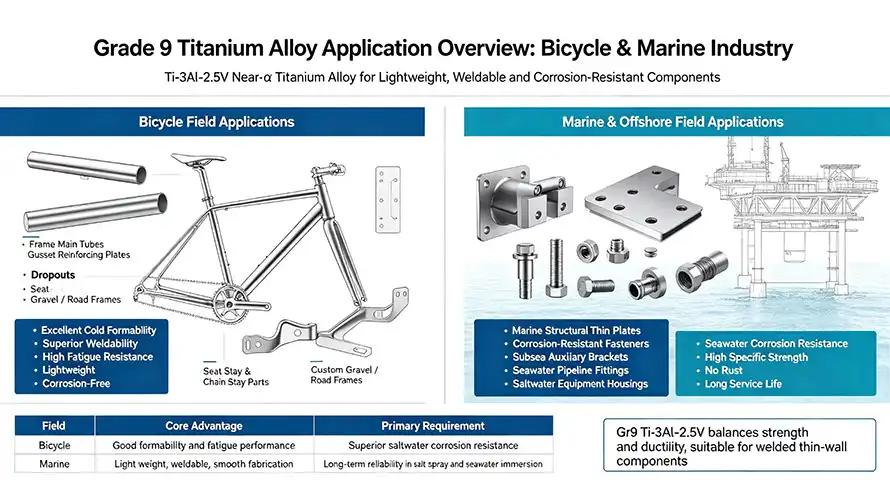
Since the 1990s, high-end bike brands in the US and Europe have bought Ti-3Al-2.5V tubing and plate for road and gravel frames. There is a lot of information about how well the metal resists fatigue under cyclic riding loads. Published fatigue data puts its endurance limit near 300 MPa, which is enough for millions of load cycles without cracking. Titanium frames last a lot longer than metal frames, which is appealing to riders who care about how much something costs in the long run.
Marine Hardware and Structural Components
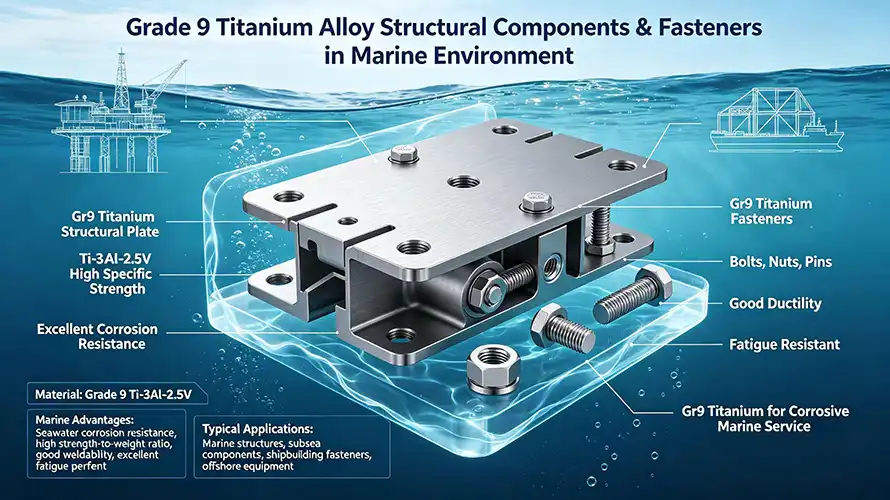
Saltwater is one of the most active places for metals to rust. Grade 9 titanium keeps a passive oxide layer in seawater up to 260°C (500°F), which is why it is used in heat exchanger plates, marine shafts, propeller hubs, and fasteners. In one documented case, Grade 9 titanium bolts were used instead of 316 stainless steel fasteners on an offshore platform grating. After 36 months of continuous saltwater exposure, the titanium hardware showed no measurable corrosion, while the stainless steel parts showed pitting within 12 months.
Procurement Lessons from Both Industries
Buyers in both sectors say that the two most common mistakes they see in buying are ordering based only on price without checking mill licenses and asking for the wrong surface condition for the welding process they want to use. By working with a supplier that gives expert review before delivery, these problems can be found before the plates are sent out.
Conclusion
Gr9 titanium plate, also known as Ti-3Al-2.5V, is a good compromise between strength and weight for bicycle and marine manufacturers. It is strong enough for structural needs, light enough for performance uses, and resistant to corrosion enough for saltwater service. Before making a purchase choice, it's important to confirm the plate's size, surface treatment, and certification standards. Next, it's important to confirm the supplier's ability to check the product. When these conditions are met, this alloy's long-term cost performance always justifies the extra money it costs per kilogram compared to steel alternatives.
FAQ
1. What thickness of Gr9 titanium plate works best for bicycle frames?
For dropouts, gussets, and bracket plates, most frame builders get plates or sheets that are 4–10 mm thick.
2. Is Gr9 titanium weldable without special equipment?
Yes, TIG (GTAW) with argon shielding makes a clean weld on Ti-3Al-2.5V. Unlike high-strength steels, it doesn't need to be heated first, which makes it easier to work with. Controlling the most important thing is making sure there is enough gas coverage during and after the weld pass.
3. Does Gr9 titanium plate meet ASTM standards for marine use?
Plates that are made to ASTM B265 and ASME SB265 meet the material requirements for most structural and pressure applications in the marine environment. Always ask for a test result on the material that is linked to the exact heat number.
4. How does Gr9 compare to Grade 7 for seawater resistance?
Palladium is added to Grade 7 (Ti-0.2Pd), which makes it more resistant to reducing acids. For normal seawater uses, though, Gr9 offers the same level of corrosion resistance at a lower alloy cost, which usually makes it the better choice for marine use.
Get a Custom Quote from Jucheng Titanium — Gr9 Titanium Plate Supplier
Jucheng Titanium has been selling Gr9 titanium plate to businesses in the US, Europe, and Southeast Asia for more than 20 years. They have 45 patents and a 3,000-ton inventory that they keep on hand. Plates from 4 mm to 80 mm thick and up to 2,500 mm wide are made at our Baoji factory according to ASTM B265, AMS 4911, and ASME SB265 standards. You can email our team at s4@juchengti.com to get a datasheet, MTR samples, or a wholesale price quote that is based on the number of items you need for your project.
References
1. ASTM International. ASTM B265: Standard Specification for Titanium and Titanium Alloy Strip, Sheet, and Plate. ASTM International, 2021.
2. AMS Committee. AMS 4911: Titanium Alloy Sheet, Strip, and Plate, 6Al-4V, Annealed. SAE International, 2019.
3. Boyer, R., Welsch, G., & Collings, E. W. Materials Properties Handbook: Titanium Alloys. ASM International, 1994.
4. Donachie, M. J. Titanium: A Technical Guide, 2nd ed. ASM International, 2000.
5. Schutz, R. W., & Thomas, D. E. "Corrosion of Titanium and Titanium Alloys." ASM Handbook, Volume 13: Corrosion. ASM International, 1987.
6. Leyens, C., & Peters, M. (Eds.). Titanium and Titanium Alloys: Fundamentals and Applications. Wiley-VCH, 2003.