


How to verify AMS 4911 titanium sheet certificate before purchase
Knowing how to verify an AMS 4911 titanium sheet certificate before purchase is one of the most practical steps any aerospace or industrial buyer can take. An AMS 4911 titanium sheet — the Ti-6Al-4V alloy in annealed condition — demands rigorous certification because it carries a minimum tensile strength of 134 ksi (924 MPa) and a yield strength of 126 ksi (869 MPa). Without proper certificate validation, buyers risk receiving non-conforming material that fails under operational stress. This guide walks through every stage of the verification process so your procurement stays compliant, traceable, and defensible.

Why AMS 4911 Titanium Sheet Certification Matters
Certification isn't just a piece of paper; it's the direct link between a sheet of paper and data that shows how well it works. You can get a license that tells you everything you need to know about where the Ti-6Al-4V plate or strip came from and what it can do.
What a Mill Test Report Contains
A proper Mill Test Report (MTR) for aerospace titanium sheet lists the chemical makeup, which includes oxygen (max 0.20%), aluminum (5.50–6.75%), vanadium (3.50–4.50%), and vanadium (3.50–4.50%). It also includes mechanical test results, heat treatment records, and the melt heat number that connects each sheet to its original ingot. The report isn't complete without all four of these parts.

Why Aerospace Standards Demand It
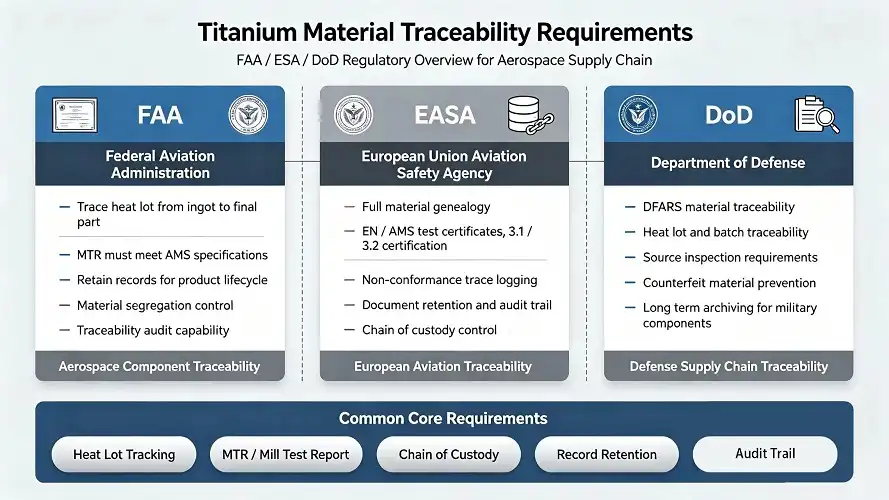
Programs that work with FAA, EASA, or DoD systems need to be able to fully track all of their materials. A certificate that meets AMS 4911 standards also verifies that the dimensions are within the ranges set by AMS 2242 and that the metal has been annealed, which has a direct effect on its ability to be shaped and its resistance to fatigue in service.
Common Verification Challenges
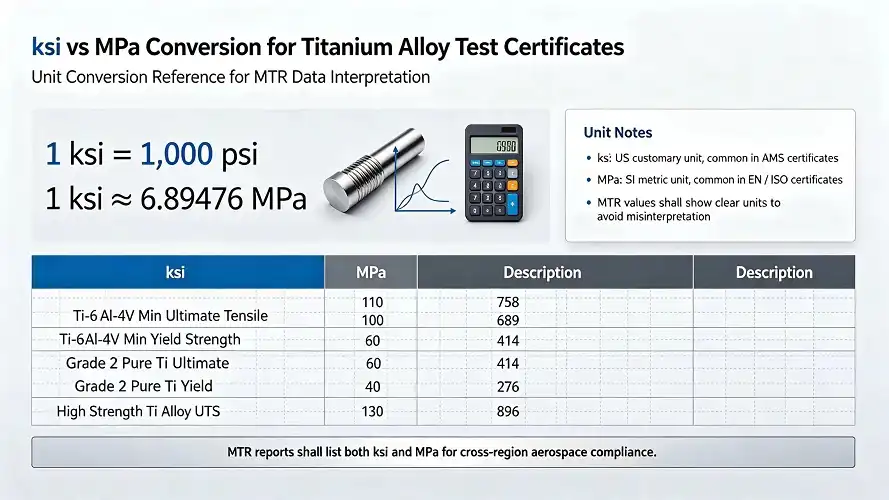
The forms of certificates are very different between sellers around the world. Some give tensile data in MPa, while others give it in ksi. The beta transus range is left out by some. If a buyer doesn't have a standard comparison plan, they might miss important gaps until the material is used in production, which is when repair costs become high.
Key Elements to Check in a Ti-6Al-4V Sheet Certificate
Go through these important data fields in a planned way before accepting any shipment of hot-rolled titanium plate or strip. There is a link between each one and a different success result.
Chemical Composition Verification
Check the numbers given against the limits set by AMS 4911 for AMS 4911 titanium sheet, which are: Al 5.50–6.75%, V 3.50–4.50%, Fe max 0.30%, N max 0.05%, and O max 0.20%. Even a small amount of extra oxygen makes things harder and less flexible. You should instantly question certificates that only name major elements and leave out interstitial limits, especially for oxygen and nitrogen.
Mechanical Property Confirmation
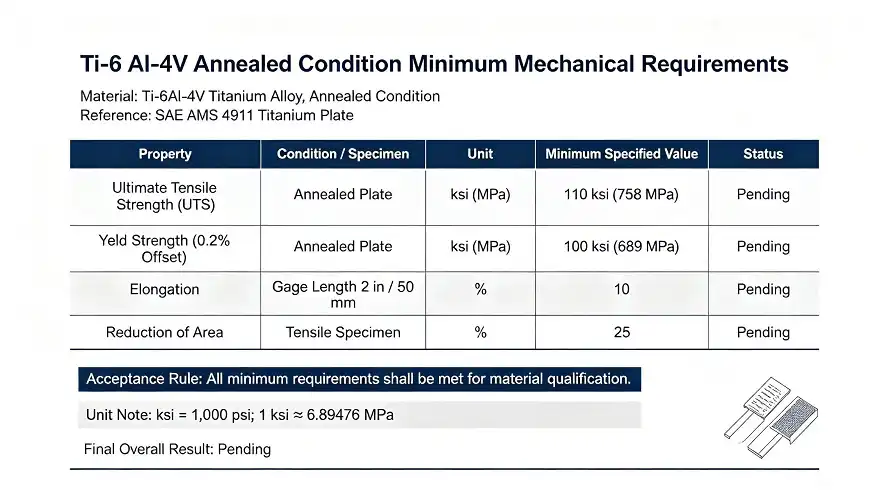
Make sure that the final tensile strength is at least 134 ksi (924 MPa) and the yield strength (0.2% shift) is at least 126 ksi. At least 10% of the length must be added. For the annealed condition, these values are correct. That stuff might not meet AMS 4911 if the certificate has lower numbers or talks about a different heat treatment state.
Traceability Data and Heat Numbers
Each certificate needs to have its own heat number, batch number, and creation date. Each sheet can be tracked back to its melt chemistry and manufacturing record using this path. Aerospace compliance checks can't use certificates that don't have traceable heat numbers, and they shouldn't be accepted by any program based on AS9100 or a similar quality system.

Step-by-Step Process to Verify AMS 4911 Certificates
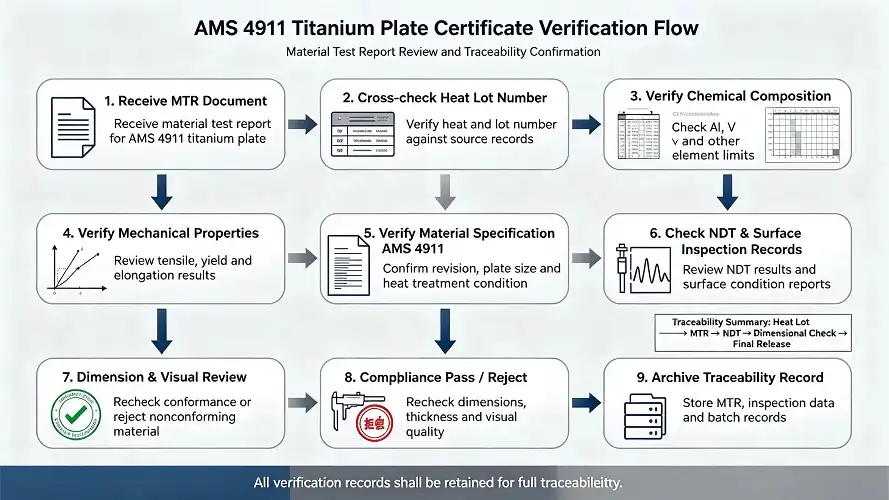
A structured workflow reduces the chance of accepting non-conforming material. Here are five steps I recommend to every procurement team sourcing aerospace-grade titanium sheet.
Step 1 — Request the Full Documentation Package
Please request that the supplier provide you with the original MTR, a certificate of compliance (CoC), and any test results that are relevant. It is essential that the CoC make the AMS 4911 revision level clear and unambiguous. In the case of titanium plates that are delivered in accordance with ASTM B265, ASME SB265, or ASTM F67 in addition to AMS 4911, it is important to cross-check that all of the standards that are quoted are fulfilled concurrently. This is particularly important when the material covers various application categories.
Step 2 — Benchmark Against Published AMS 4911 Requirements
You may get the most recent version of AMS 4911 by downloading it straight from SAE International. The stated values of the certificate should be placed next to the limitations specified in the specification. It is important to pay attention to the elongation requirements that vary depending on the thickness of the sheet. Sheets that are thinner than 0.025 inches have somewhat different elongation thresholds than heavier plate that is up to 80 mm thick.
Step 3 — Confirm Supplier Credentials
Make sure you find out if the provider has received accreditation from Nadcap, ISO 9001, or AS9100. Perform a cross-reference between their name and the authorised distributor lists that are kept by major aerospace prime organisations. The Baoji Jucheng Titanium Industry Co., Ltd. is in possession of four innovation patents and forty-one utility model patents. Additionally, the company works under established quality procedures, which is the type of credential transparency that you should anticipate from any supplier that you examine.
Step 4 — Commission Independent Third-Party Testing
When it comes to high-criticality aerospace or defence applications, it is recommended to submit sample pieces to an independent laboratory that has been certified for the purpose of conducting chemical analysis and assessing mechanical properties. The expense of this stage is increased, but it ensures that the actual material is consistent with what is stated on the certificate. A great number of programs demand this as a prerequisite for the acceptance of the initial piece.
Step 5 — Align Export and Logistics Documents
Ensure that the packing list, commercial invoice, and export documentation for AMS 4911 titanium sheet reference the same heat numbers shown on the MTR. Discrepancies between shipping documents and certificates create customs clearance problems and raise immediate questions about material authenticity. Jucheng Titanium maintains consistent documentation from factory to delivery, which is something worth verifying with any supplier you consider.

Common Red Flags in Titanium Sheet Certification
Your supply chain may be prevented from being disrupted in ways that are very expensive if you are able to recognise warning indications at an early stage. Here is a summary of the most prevalent difficulties, along with some possible explanations for each one.
- Incomplete chemical composition tables: The certificate is unable to establish conformity with AMS 4911 if the values for iron, oxygen, nitrogen, or hydrogen are absent. An exception-free list of all regulated items is included in a report that is compliant.
- Lacking an official stamp or a signature that is authorised: It is possible to identify a genuine MTR by the stamp of the mill that issued it as well as the signature of the quality authority. Documents that are not signed or stamped may be an indication that the certificate has been reissued or changed.
- One of the most important deficiencies is that there is neither a heat nor a lot traceability number. There is no audit trail in existence if there is no heat number. Any program in the aerospace industry that accepts such material is in violation of its own commitments regarding traceability.
- Pricing that is much lower than market benchmarks: There is a predictable pricing range for Ti-6Al-4V hot-rolled sheet in annealed state. This sheet is treated via rolling, annealing, levelling, pickling, and surface finishing to either polished, machined, or acid-pickled finishes. Quotations 30–40% below market are often indicative of stock that has been downgraded or is not certified.
Regarding these hues, there is no room for debate. There is a well-known problem of certificate fraud in the metal distribution sector, as shown by the industry's consistent and high-quality statistics. Both the Aviation Suppliers Association and the SAE are responsible for sending notifications to procurement teams on a consistent basis.

Best Practices for B2B Procurement of Aerospace Titanium Sheet
As time passes, having solid purchasing habits makes it simpler to examine items and strengthens the supply chain from the inside out. Rather than going via unreliable intermediaries, the most user-friendly method for purchasers to get genuine certificates is to purchase them directly from a firm that has shown its capacity for research and development. More than five hundred distinct types of goods are manufactured by Jucheng Titanium, which has its headquarters in the titanium industrial zone of Baoji. Titanium sheets are available in grades Gr1, Gr2, Gr4, Gr5, Gr7, Gr9, and Gr12, with thicknesses ranging from 4 mm to 80 mm, widths ranging from 950 mm to 2500 mm, and lengths extending up to 10,000 mm. Additionally, it is possible to order titanium sheets in bespoke sizes. The standards that are covered include, but are not limited to, ASTM B265, ASTM F67, AMS 4911, and ASME SB265. An annealed condition is supplied to each and every piece of steel after it has been hot-rolled. Due to the fact that around 3,000 tonnes of titanium are maintained in store throughout the year, lead times remain competitive.
It is possible to clear up all transactions by including certificate verification on your standard purchase order form and by creating attachments for MTR, CoC, and heat tracking that must be received before items are accepted.

Conclusion
Checking an AMS 4911 titanium sheet license before buying it is a clear, repeatable process, not a decision that you have to make on the spot. Buyers can be sure that their Ti-6Al-4V titanium sheet will work as expected by checking its chemical makeup, mechanical qualities, heat tracking, seller credentials, and the alignment of its export paperwork. Certificate gaps aren't small paperwork problems; in the defense and aerospace industries, they mean extra work, rejection, or program risk. The steps described here can be used by any business that needs to get titanium sheet for structural, high-temperature, or corrosion-resistant uses.
FAQ
1. What is the difference between AMS 4911 and ASTM B265 Grade 5?
AMS 4911 is a standard that is particular to the aerospace industry and has criteria for testing, processing, and microstructure that are more stringent than those of ASTM B265 Grade 5. The American National Standards Institute (AMS) 4911 defines a standard alpha-beta structure that is free from continuous alpha networks. Additionally, it requires more stringent traceability documentation that is suitable for aerospace projects that are controlled by AS950.
2. When is a supplier-provided certificate sufficient?
An MTR that is supplied by the supplier is adequate for a wide variety of industrial applications, provided that the provider has either ISO 9001 or AS9100 certification and that the certificate contains comprehensive chemical, mechanical, and traceability data. When it comes to defence contracts or first-article aerospace certification, independent third-party lab verification is often necessary.
3. How long is a titanium sheet certificate valid?
There is no expiration date on certificates themselves; nevertheless, the state of the material may alter if it is stored improperly. It is recommended that annealed Ti-6Al-4V sheet be kept in an environment that is both dry and climate-controlled. Re-inspection is often requested by purchasers prior to the use of the material in critical applications if it has been stored for more than twenty-four months.
4. Can I weld AMS 4911 titanium sheet?
It is possible to weld AMS 4911 sheet using TIG, MIG, or laser welding, provided that high-purity inert gas shielding is maintained during the whole process. This is done to avoid ambient contamination and embrittlement.
Partner With Jucheng Titanium for Certified AMS 4911 Titanium Sheet
For more than 20 years, Jucheng Titanium has sold checked and traceable titanium materials to chemical and industrial users in the US and other countries. We are a National High-Tech Enterprise with 45 patents and direct factory production. For every order of AMS 4911 titanium sheet, we include full MTR packages, reasonable bulk prices, and paperwork at the maker level. Feel free to email our expert team at s4@juchengti.com to get a price and look over our certification paperwork right away.

References
1. SAE International. AMS 4911: Titanium Alloy, Sheet, Strip, and Plate 6Al-4V, Annealed. SAE International, 2015.
2. ASTM International. ASTM B265: Standard Specification for Titanium and Titanium Alloy Strip, Sheet, and Plate. ASTM International, 2020.
3. Aviation Suppliers Association. Counterfeit Parts Prevention and Certificate Verification Guidelines. ASA, 2019.
4. Donachie, Matthew J. Titanium: A Technical Guide. 2nd ed. ASM International, 2000.
5. National Aeronautics and Space Administration. NASA-STD-6008: NASA Welding Standard. NASA, 2008.
6. Boyer, Rodney R., Gerhard Welsch, and E. W. Collings, eds. Materials Properties Handbook: Titanium Alloys. ASM International, 1994.