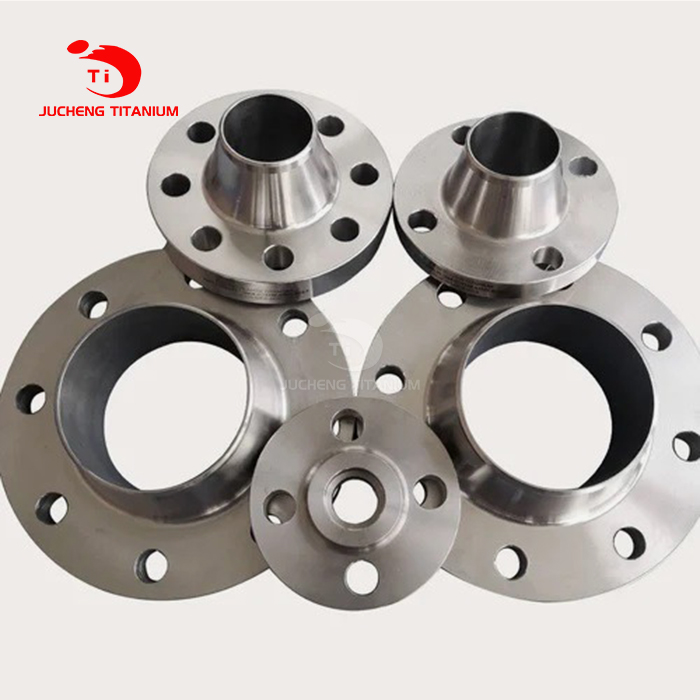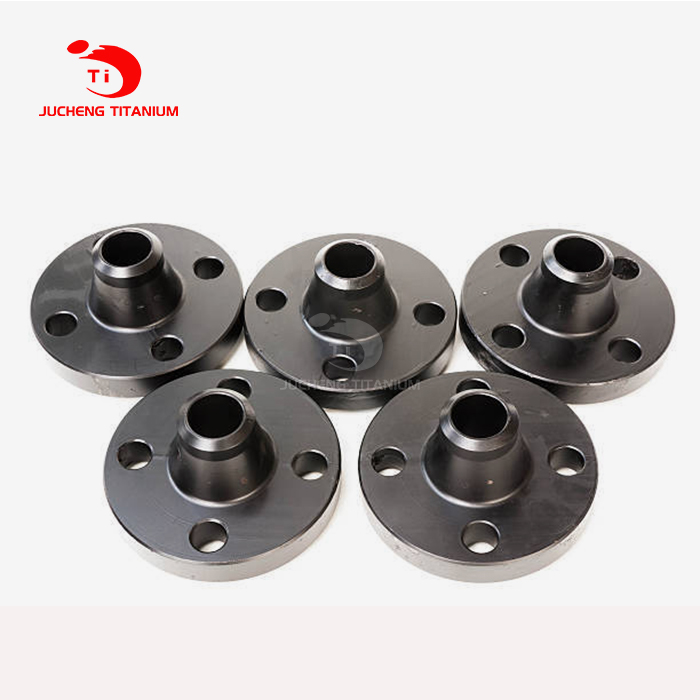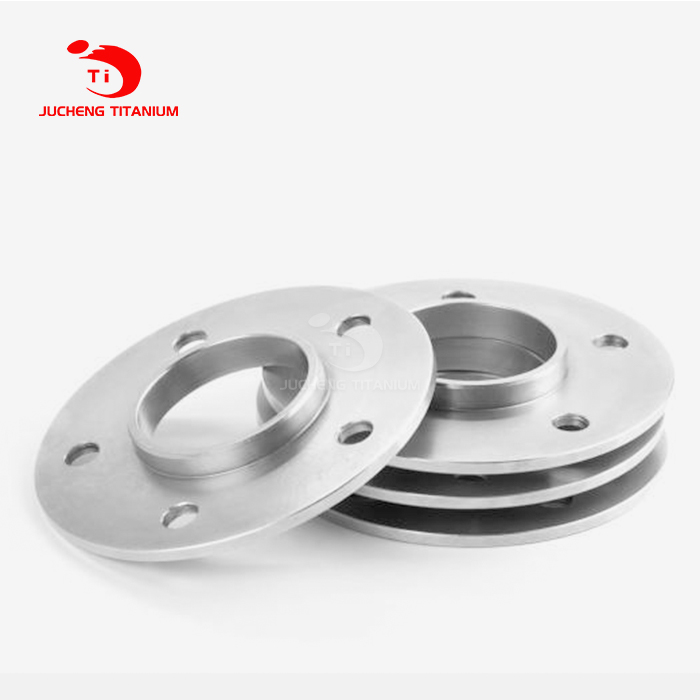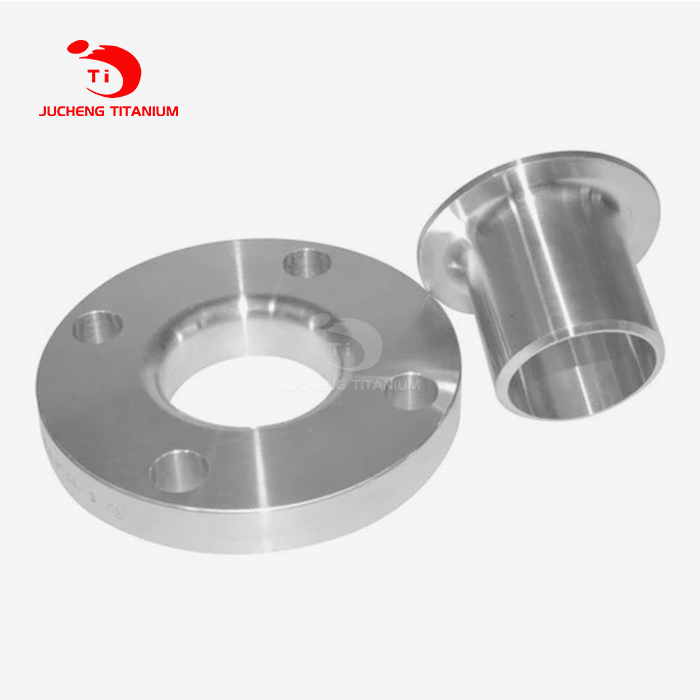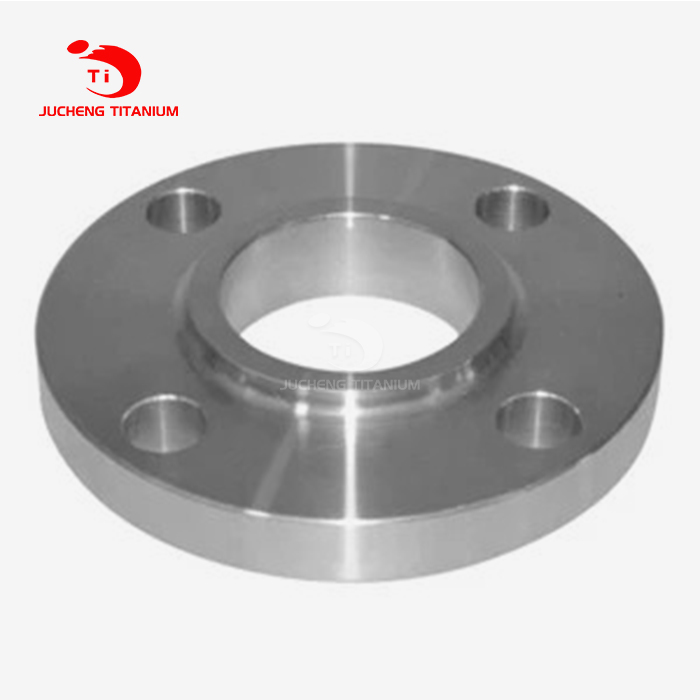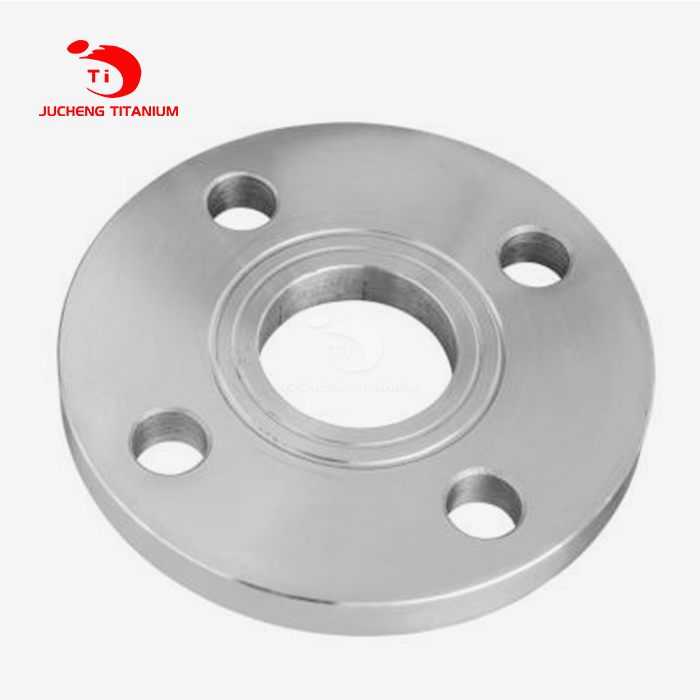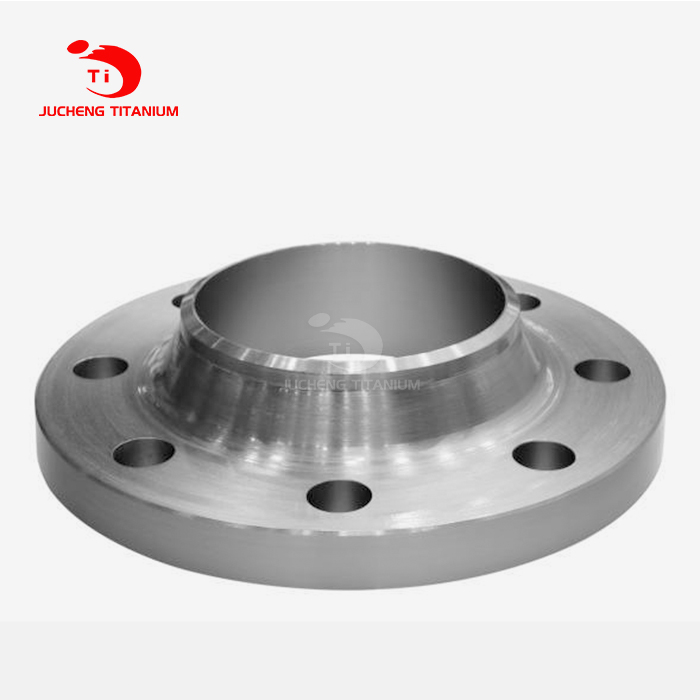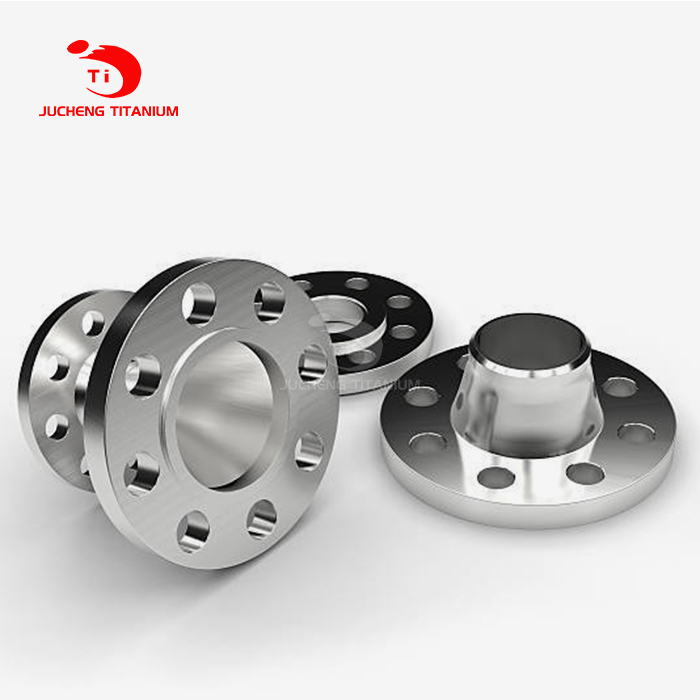

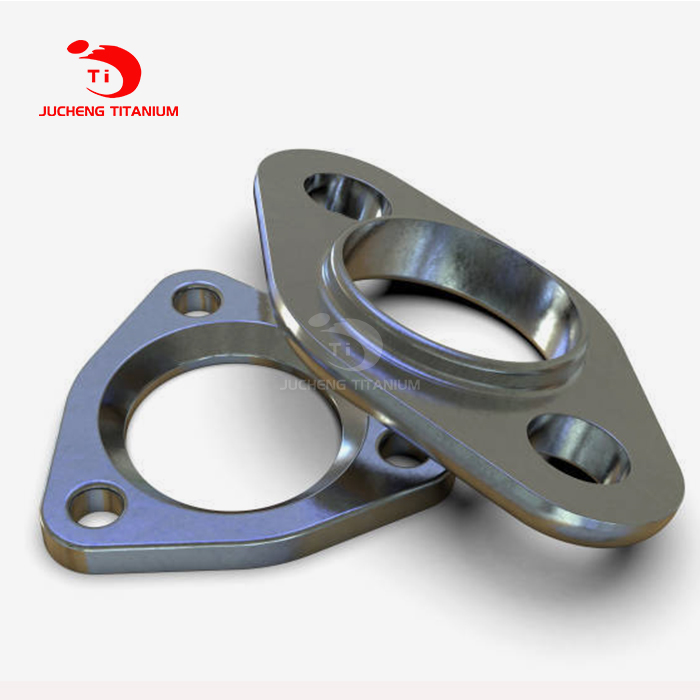
titanium exhaust flange
2.Size: NPS 1/2″ – 48″ (DN15 – DN1200), custom larger sizes available, Thickness: Sch5S – Sch160, XXS
3.Standard: ASME/ANSI B16.5, ASME B16.47, MSS SP-44, DIN 2631-2638, EN 1092-1, AWWA C207, JIS B2220, GB/T 9112, HG/T 20592
4.Type: Weld Neck (WN), Slip-On (SO), Blind (BL), Socket Weld (SW), Threaded (THR), Lap Joint (LJ), Plate, Orifice, Long Weld Neck
5. Processing Method: Titanium ingot → Forging → Heat treatment → CNC machining → Drilling → Surface finishing → Marking
6.State: Annealed
7.Surface Treatment: Machined bright
- Product Description
Titanium Exhaust Flange – Lightweight, High-Strength Connection for High-Performance Systems
Precision-engineered titanium exhaust flange designed to satisfy the exacting demands of motorsport and high-temperature applications are the specialty of Baoji Jucheng Titanium Industry Co., Ltd. With more than 500 sets of titanium equipment produced each year and more than 20 years of experience in titanium processing, we provide flanges made of Grade 2 and Grade 5 titanium that are 40–50% lighter than stainless steel. Our flanges guarantee flawless mating surface flatness because they adhere to stringent ISO 2768-m standards. Our products, which are supported by 3,000 tons of titanium inventory for quick fulfillment, are used in the aerospace, motorsport, and marine industries where corrosion resistance and thermal stability are essential.
 |  |  |  |
What Makes Our Titanium Exhaust Flange Superior
The vital point of connection for high-performance exhaust systems is a titanium flange. It precisely and leak-proofly connects pipes, headers, or turbochargers.
Our flanges form a protective coating of TiO2 oxide, in contrast to steel flanges that oxidize and scale above 500°C. This uses intense heat cycling to guarantee structural integrity.
The melting point of your system is 1,668°C, which is significantly higher than the usual exhaust gas temperatures of 800–900°C. This keeps forced-induction engines from warping and preserves airtight sealing.
Better dimensional stability results from a reduced coefficient of thermal expansion. Under high heat, you avoid the typical warping problems with stainless steel.
Technical Specifications
Parameter | Details |
Grade | Gr1, Gr2, Gr5 (Ti-6Al-4V), Gr7, Gr9, Gr12, Gr23 (Ti-6Al-4V ELI) |
Size Range | NPS 1/2″ – 48″ (DN15 – DN1200), custom larger sizes available |
Thickness | Sch5S – Sch160, XXS |
Standards | ASME/ANSI B16.5, ASME B16.47, MSS SP-44, DIN 2631-2638, EN 1092-1, AWWA C207, JIS B2220, GB/T 9112, HG/T 20592 |
Flange Types | Weld Neck (WN), Slip-On (SO), Blind (BL), Socket Weld (SW), Threaded (THR), Lap Joint (LJ), Plate, Orifice, Long Weld Neck |
Density | 4.51 g/cm³ (45% lighter than steel) |
Yield Strength | Grade 2: ~275 MPa / Grade 5: up to 895 MPa |
Melting Point | 1,668°C (3,034°F) |
State | Annealed |
Surface Treatment | Machined bright finish |
 |  |  |
 |  |  |
Manufacturing Process
A rigorous seven-step process is used to create our titanium flanges:
Forging, marking, CNC machining, precision drilling, heat treatment, surface finishing, and titanium ingot selection
Our skilled quality control team keeps an eye on every step. We ensure that bolt-hole alignment and flatness tolerance satisfy aerospace-grade standards in accordance with ASTM B265 and AMS 4911.
Grain structure is optimized by heat treatment to prevent intergranular cracking. The ideal mating surface required for leak-free sealing is produced via CNC machining.
Key Performance Advantages
Weight Reduction: Compared to 304 stainless steel, you save 40–50% on weight. This enhances throttle responsiveness and reduces unsprung weight in racing applications.
Thermal Stability: At very high temperatures, Grade 5 flanges are resistant to bending under bolt strain. Your flange retains its dimensional integrity even at 900°C EGT.
Corrosion Immunity: The passive TiO2 coating guards against moisture, road salts, and acidic exhaust condensates. In cold and sea conditions, your flange outlasts steel.
Superior Strength: Tensile strength of up to 895 MPa is provided by Grade 5 versions. In high-pressure turbo configurations with extreme clamping stresses, this avoids warping.
 |  |  |  |
Application Scenarios
Professional Motorsports: Formula 1 and GT3 teams use our flanges in headers and mid-pipes. Every gram matters when exhaust gas temperatures exceed 800°C.
Aftermarket Supercar Tuning: Lamborghini and Porsche builders rely on our flanges for thin-walled titanium exhaust systems. Perfect sealing is maintained despite rapid thermal expansion and contraction.
Marine and Aerospace Propulsion: Lightweight UAV exhaust systems and high-speed marine craft demand salt-spray corrosion resistance. Our titanium exhaust flange delivers long-term reliability in oxygen-rich, moisture-heavy environments.
 |  |  |
 |  |  |

FAQ
Q: Is it possible to fuse a titanium flange to a pipe made of stainless steel?
A: No. When titanium and steel are welded, brittle intermetallic compounds (FeTi) are produced, which break easily. When combining materials, use a mechanical connection such as a loose-flange design or a V-band.
Q: Which grade is superior, Grade 2 or Grade 5?
A: To match tube ductility when welding flanges to titanium tubing, select Grade 2. For loose flanges or clamps that need more hardness and tensile strength to withstand bending under bolt strain, choose Grade 5.
Q: How can bolt seizing (galling) be avoided?
A: Galling is a common occurrence in titanium. Use silver-plated nuts or high-temperature nickel-based anti-seize lubricant. Inconel studs, on the other hand, stop thread seizing.
Q: Does the flange exhibit stainless steel-like warping?
A: Because of its reduced thermal expansion, it resists warping. However, with excessive turbo heat, warping may be caused by inadequate thickness (<8mm) or incorrect torque sequencing.
Q: What caused my flange's color to change?
A: At high temperatures, natural oxidation takes place. At about 300°C, gold appears, followed by purple at about 400°C and blue over 500°C. This patina shows heat zones and verifies that the titanium is real.
Contact Us
Ready to upgrade your exhaust system with precision-engineered titanium exhaust flange? Reach out to our team at s4@juchengti.com for custom specifications and fast delivery from our 3,000-ton inventory.