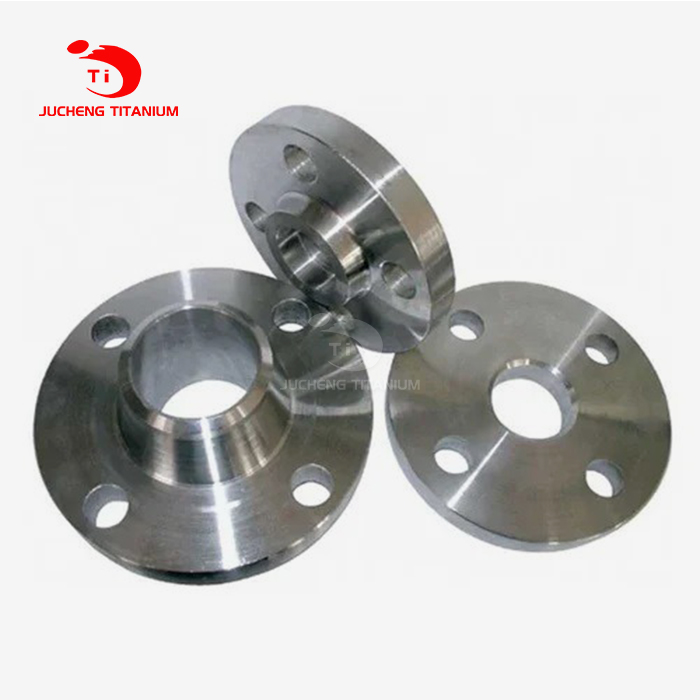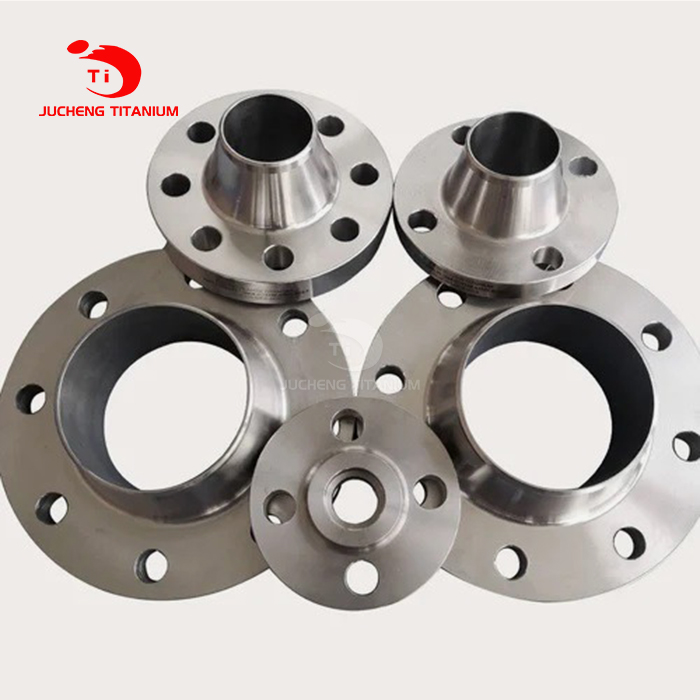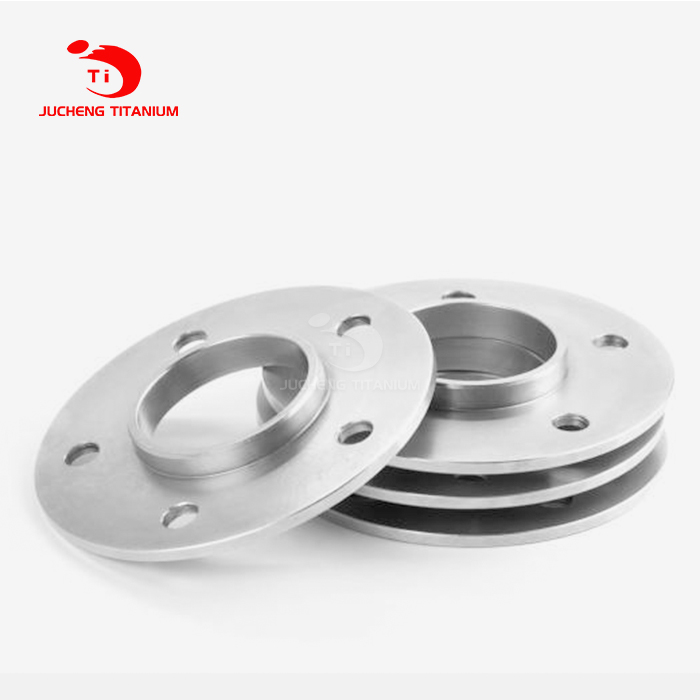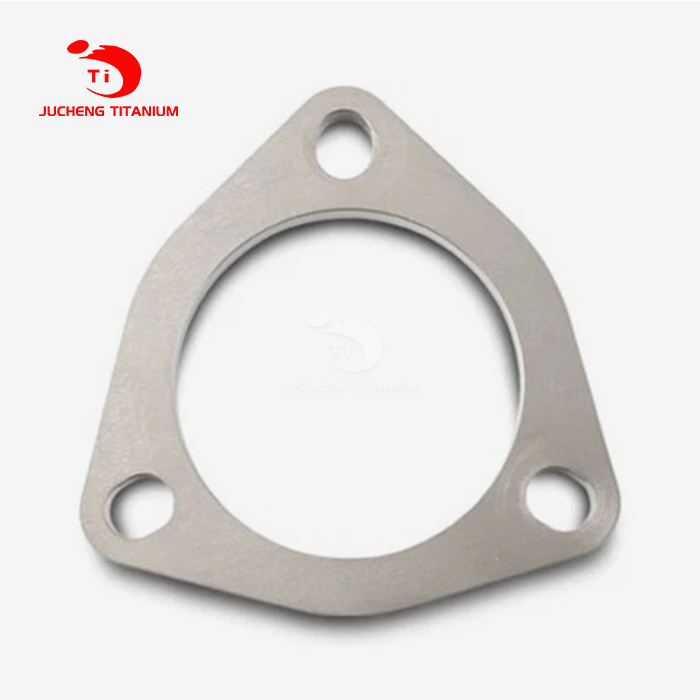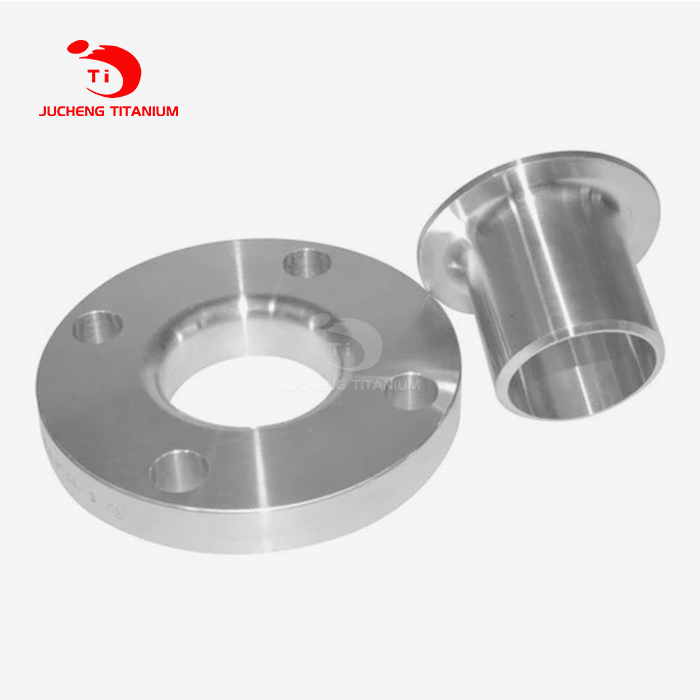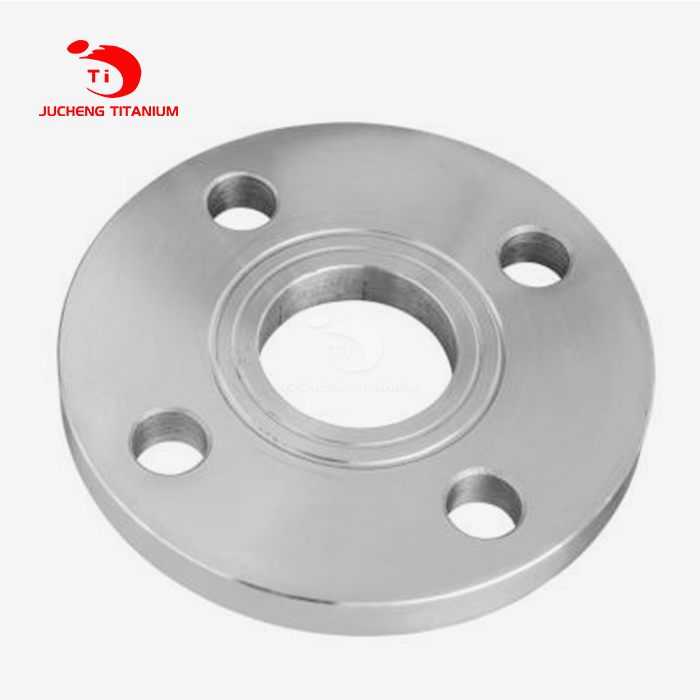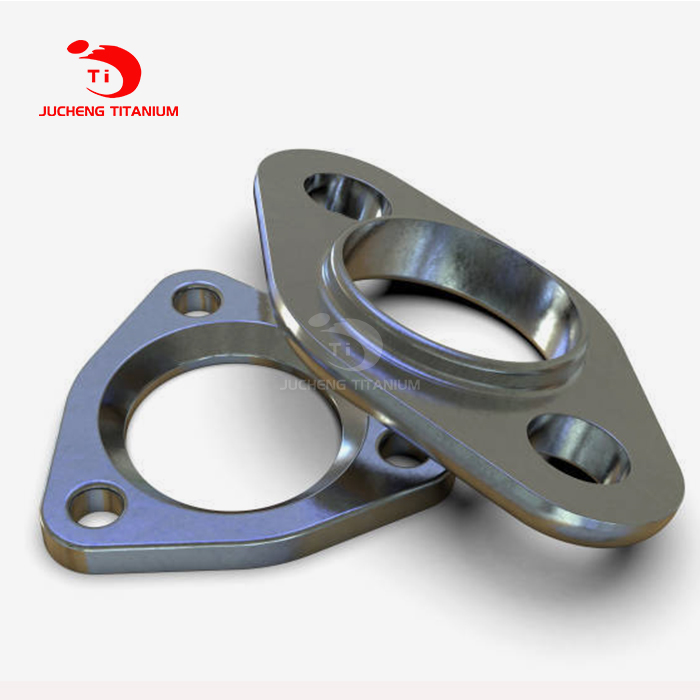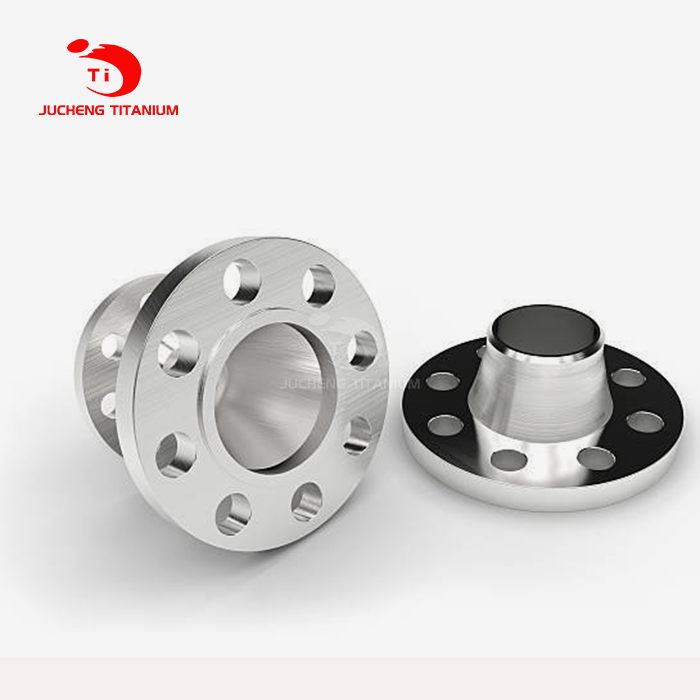

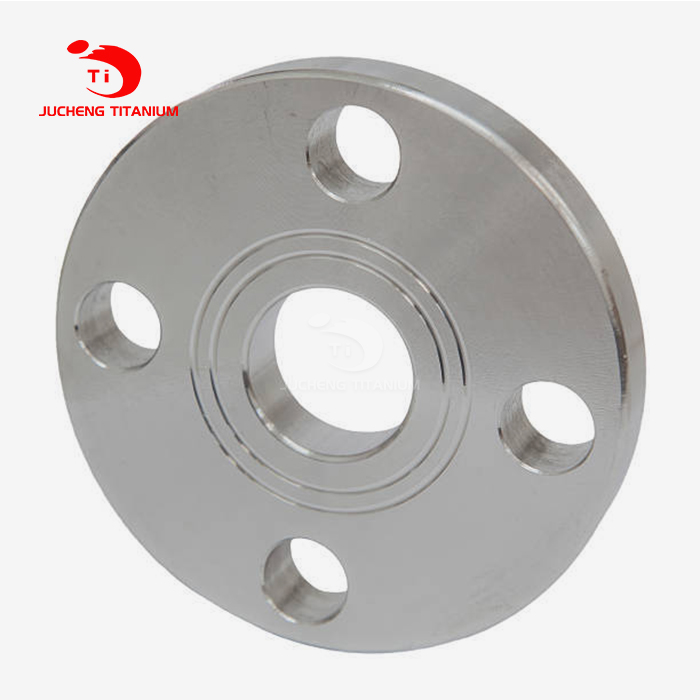
pressure forged titanium flanges
2.Size: NPS 1/2″ – 48″ (DN15 – DN1200), custom larger sizes available, Thickness: Sch5S – Sch160, XXS
3.Standard: ASME/ANSI B16.5, ASME B16.47, MSS SP-44, DIN 2631-2638, EN 1092-1, AWWA C207, JIS B2220, GB/T 9112, HG/T 20592
4.Type: Weld Neck (WN), Slip-On (SO), Blind (BL), Socket Weld (SW), Threaded (THR), Lap Joint (LJ), Plate, Orifice, Long Weld Neck
5. Processing Method: Titanium ingot → Forging → Heat treatment → CNC machining → Drilling → Surface finishing → Marking
6.State: Annealed
7.Surface Treatment: Machined bright
- Product Description
Pressure Forged Titanium Flanges Enterprise-Grade Performance from Baoji Jucheng Titanium
Baoji Jucheng Titanium Industry Co., Ltd. uses exact thermodynamic forging techniques to pressure forged titanium flanges.Titanium billets with ASTM B381 certification, such as Gr2, Gr5 (Ti-6Al-4V), Gr7, and Gr12, are used to make these parts.Controlled grain alignment is used in the process to lower porosity and enhance quality.We can produce parts for big projects fast because to our 3,000-ton titanium stock and more than 20 years of titanium manufacturing experience.
Our facility collaborates with the Northwest Nonferrous Metals Research Institute and is supported by 45 patents.Every year, we manufacture around 500 sets of titanium equipment.Our products' tensile strength, which ranges from 345 MPa to 895 MPa, satisfies ASME B16.5/B16.47 requirements for Class 150–2500 ratings.
 |  |  |  |
What Makes Pressure Forging Superior
Traditional machining and casting methods create internal weaknesses. Pressure forging applies extreme compressive forces to titanium billets under controlled temperatures. This process refines grain structure and eliminates microscopic voids.
The result? Components that resist stress corrosion cracking in chloride environments. You get leak-proof sealing where failure means catastrophic consequences.
Our closed-die forging aligns metal grain flow with flange contours. This directional strength handles cyclic pressure loading far better than machined alternatives.
Technical Specifications Of pressure forged titanium flanges
Parameter | Details |
Grade | Gr1, Gr2, Gr5 (Ti-6Al-4V), Gr7, Gr9, Gr12, Gr23 (Ti-6Al-4V ELI) |
Size Range | NPS 1/2″ – 48″ (DN15 – DN1200), custom larger sizes |
Thickness | Sch5S – Sch160, XXS |
Standards | ASME/ANSI B16.5, ASME B16.47, MSS SP-44, DIN 2631-2638, EN 1092-1, JIS B2220, GB/T 9112 |
Types | Weld Neck (WN), Slip-On (SO), Blind (BL), Socket Weld (SW), Threaded (THR), Lap Joint (LJ), Plate, Orifice |
Processing | Titanium ingot → Forging → Heat treatment → CNC machining → Drilling → Surface finishing → Marking |
State | Annealed |
Surface | Machined bright |
Density | 4.51 g/cm³ (45% lighter than stainless steel) |
Tensile Strength | 345 MPa (Gr2) to 895+ MPa (Gr5) |
 |  |  |
 |  |  |
Key Performance Advantages
Immunity to Corrosion
A stable layer of TiO2 oxide is spontaneously formed by titanium. In seawater and oxidizing acids, this protective coating is resistant to stress corrosion cracking, pitting, and crevice corrosion. Where stainless steel would break, your system remains intact.
Outstanding Ratio of Strength to Weight
These flanges lower structural load without sacrificing integrity since they are 45% lighter than steel. For demanding applications, the high-strength Grade 5 alloy offers a tensile strength of 895 MPa.
Longer Service Life
Impact hardness and fatigue resistance are enhanced by forged grain structure. Subsea installations have lifecycles of more than 25 years with no upkeep.
Stability at High Temperatures
Up to 400°C, these parts retain their mechanical qualities. In aerospace applications, thermal cycling does not affect structural dependability.
 |  |  |  |
Industrial Applications
Subsea Oil & Gas Systems
Pressure forged titanium flanges perform in subsea manifolds and Christmas trees. They withstand extreme hydrostatic pressure and seawater corrosion for decades.
Chemical Processing Plants
In PTA production and desalination facilities, these flanges handle aggressive oxidizing acids and high-concentration chlorides. Zero pitting where other materials corrode rapidly.
Aerospace Engineering
High-pressure fuel systems demand weight reduction without sacrificing integrity. Our flanges endure extreme vibration and thermal stress in aircraft and defense applications.
Marine Engineering
Shipbuilding and offshore platforms require components that resist saltwater indefinitely. These flanges provide reliable connections in the harshest maritime conditions.
 |  |  |
 |  |  |

FAQ
Q: What pressure ratings do you support?
A: We manufacture flanges meeting Class 150 through Class 2500 ratings per ASME B16.5 and B16.47 standards. Custom pressure specifications available upon request.
Q: How does forging improve flange performance?
A: Forging eliminates casting porosity and refines grain structure. This creates superior fatigue resistance and leak-proof sealing under cyclic loading conditions.
Q: Can you provide custom sizes beyond standard ranges?
A: Yes. Our 120,000 square meter facility handles custom dimensions larger than NPS 48″. Send your engineering drawings for evaluation.
Q: What certifications verify quality?
A: All products comply with ASTM B381 material standards. We're a National High-Tech Enterprise with 45 patents and strict quality control systems.
Q: What's your typical delivery timeframe?
A: Our 3,000-ton titanium inventory enables rapid fulfillment. Lead times vary by specification—contact us with your project timeline for accurate estimates.
Contact Us for Custom Solutions
Need pressure forged titanium flanges for your critical application? Our technical team provides customized solutions based on your specifications. Reach us at s4@juchengti.com to discuss your requirements today.